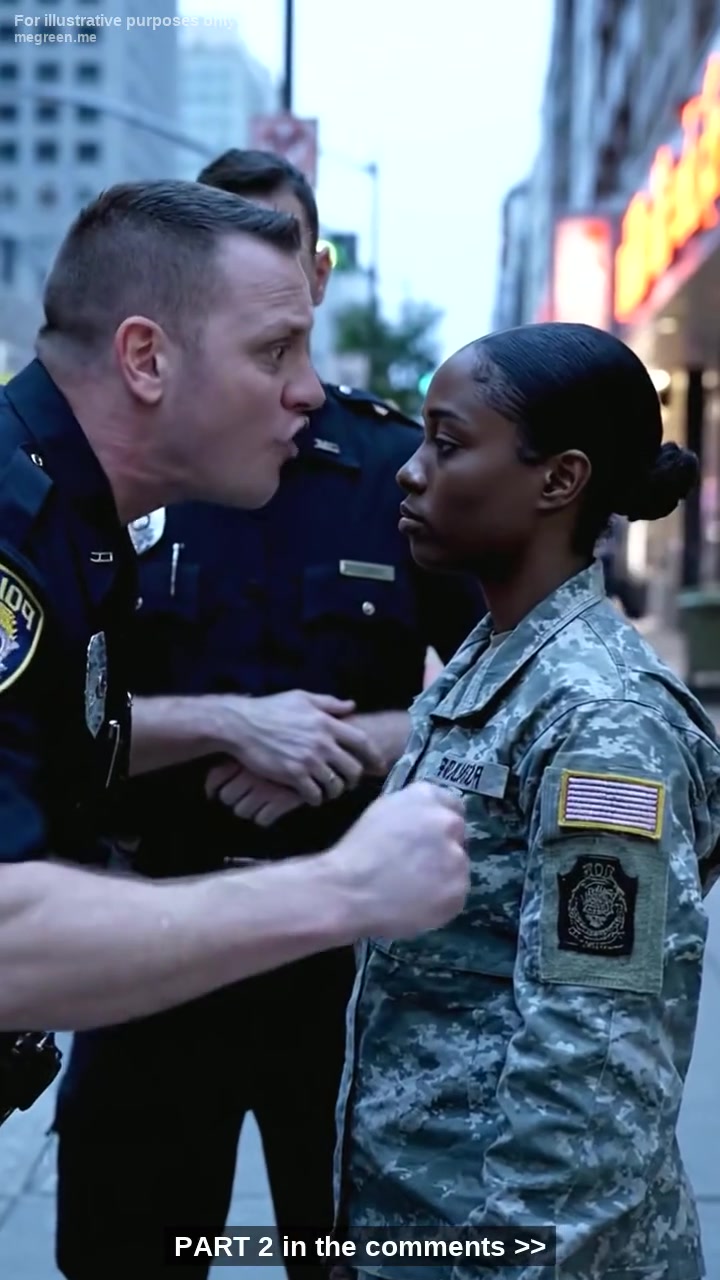
The heat was the first thing I noticed. That thick, oppressive, mid-July Virginia asphalt-and-exhaust heat that sinks into your bones.
I was in my official government SUV, windows down, letting the air circulate. I was in my full-service dress uniform – Army Greens, perfectly pressed. The four stars on my shoulder glinted in the harsh sun. I was on my way from the Pentagon to a briefing at Fort Belvoir. I was also a Black woman, alone, in an expensive vehicle. In this neighborhood, that was apparently probable cause.
The sirens wailed. I saw the lights flashing in my rearview, and I pulled over immediately, my hands visible on the wheel. Standard procedure. Two officers approached, one on each side. They were local police. The one at my window, his name tag read ‘COLE’, was a big man, his face flushed red from the heat and something else. Something ugly. He didn’t ask for my license. He didn’t ask for registration. He just… stared. He looked at my uniform. He looked at my skin. He looked at the official Pentagon badge on my dash. And then he sneered.
“”“Who are you going to call, black?” he shouted, his voice jarring in the quiet afternoon. I blinked. Confused, not by the words, but by the immediate, unprovoked venom. “”“I’m sorry, Officer. Is there a problem?” “”“The problem,” his partner, ‘HENKINS’, chimed in from the other side, “”“is that you’re in a car that doesn’t belong to you, dressed like you’re playing soldier.” Cole laughed. A harsh, barking sound. “”“Go back to Africa, where you belong,” he said.
My blood didn’t run hot. It ran cold. This was not a traffic stop. This was a hate crime in progress. I kept my voice steady. Military calm. “”“My name is General Regina M. Cal. That is my Pentagon identification on the dash. This is my assigned government vehicle. You are currently in violation of – “”
“”“Shut up!” Cole yelled, his hand already on his weapon. He wasn’t listening. He didn’t want to listen. He ripped open my door. “”“I don’t care if you say you’re Michelle Obama, Black. This car is stolen, and you’re under arrest.” Before I could react, before I could even unbuckle my seatbelt, he grabbed my arm and yanked me out of the seat. I hit the hot asphalt, my shoulder scraping the pavement. “”“I am a four-star General!” I said, my voice sharp, a command. “”“Yeah, and I’m the King of England,” Henkins mocked, laughing as he circled us, feigning inspection. “”“Pentagon badges… who gave them to you? Your pimp?”
They shoved my face against the hot metal of the SUV. The cold click of the handcuffs was shockingly loud. They bit into my skin. “”“Don’t cry, baby,” Henkins whispered in my ear, his grin sickening. “”“Hopefully, they’ll treat you better than we do in jail… or they’ll make you clean toilets. Give me my phone now.” “”“Your phone?” Henkins mocked, rifling through the SUV as if it were his property. He pulled out the device. My government-issued, secure iPhone. “”“What’s this?” he scoffed, holding it up like a trophy. “”“A f***ing government iPhone… Man, this country has gone to hell.” He waved it in front of my face. “”“Who gave it to you, black girl? Did you steal it, or did you take it from some soldier after warming his bed?”
Sergeant Cole let out that harsh laugh again. He yanked the cuffs, tightening them until I felt the metal bite into the bone. Red marks instantly appeared. “”“I wouldn’t be surprised if you’re part of those military inclusion experiments,” he said, his voice laced with years of pent-up hatred. “”“They give suits and titles to any little girl now. And look… they even learn to speak properly.”
I swallowed. I focused on the shimmering heat rising from the asphalt. “”“You’re violating federal protocols,” I managed to say, my voice strained from the pressure on my arms. At that moment, something in me shifted. Not fear. Not rage. Something colder. Sharper. I closed my eyes, breathing slow. Counting. They were shoving me against the cruiser, like a common thief. My full uniform. My name tag. My General’s stars, clearly visible. My ID badge, tossed carelessly on the hood. Still, they didn’t stop. They didn’t scan the badge. They didn’t run my name. They weren’t interested in truth. They were interested in control. And they had just made the biggest mistake of their lives.
The ride to the precinct was bumpy. Every jolt sent a fresh throb of pain through my wrists. My mind, however, remained a calm, strategic fortress. I focused on the plan.
The air in the police station smelled stale, like old coffee and fear. I was led through a grimy hallway to a small interrogation room. Its walls were bare, painted a sickly beige.
“”“Sit,” Cole grunted, shoving me into a hard plastic chair. He still had that sneer fixed on his face. Henkins leaned against the doorframe, watching with amusement.
“”“I am entitled to one phone call,” I stated, my voice unwavering. My gaze met Cole’s, challenging him. He scoffed, rolling his eyes dramatically.
“”“Oh, a phone call, is it? Who are you gonna call, your parole officer?” he sneered. “”“Sure, princess, make your call. But make it quick. We got paperwork to do.” He pulled a cheap flip phone from his belt, tossing it onto the table. It slid across the surface, stopping just short of my cuffed hands.
I picked it up with some difficulty. My fingers, still numb from the cuffs, fumbled with the tiny buttons. I knew the number by heart. It was etched into my memory, a direct line.
I dialed. The phone rang once, twice. Then a crisp, professional voice answered. “”“Office of the Secretary of Defense, Aide-de-Camp Major Evans speaking. How may I help you?”
I took a deep breath. “”“Major Evans, this is General Regina Cal. I am currently being held under unlawful arrest at the [redacted] Precinct in Fairfax County, Virginia. I require immediate assistance.” My voice carried the full weight of my rank and the gravity of the situation.
Cole and Henkins exchanged a look. Their smirks faltered slightly. They had expected a sob story, not a military formality.
Major Evans’s voice immediately shifted. “”“General Cal? Ma’am, are you alright? Can you confirm your location and current status?” There was an urgent edge to his tone now.
I gave him the address of the precinct. “”“I am cuffed and being detained on fabricated charges. Officers Cole and Henkins are present. They refuse to acknowledge my identity or rank.” I kept my words precise, leaving no room for misunderstanding.
“”“Understood, General. Stay calm. We are mobilizing resources immediately. The Secretary will be informed. Help is on the way.” Major Evans’s voice was firm, reassuring.
I heard the click as he disconnected. I placed the phone back on the table. Cole and Henkins stared at me, their faces now a mix of confusion and dawning apprehension. The mockery had vanished.
“”“Who was that, your lawyer?” Cole asked, trying to regain his bravado. But his voice lacked its earlier conviction.
“”“That was Major Evans, Aide-de-Camp to the Secretary of Defense,” I replied calmly. “”“You should expect federal intervention very soon.”
A chilling silence filled the room. Henkins’s eyes darted nervously between me and Cole. The bravado had completely evaporated. Cole’s face, previously red with anger, turned a sickly pale.
They left the room without another word, closing the door softly behind them. I could hear their hushed, frantic whispers through the thin walls. The silence stretched, broken only by the distant hum of the station.
Minutes turned into an eternity. I sat, my shoulders aching, my wrists throbbing. But a deep sense of satisfaction began to bloom within me. They had dug their own graves.
Then, a new sound. Distant sirens, growing louder, multiplying. Not the familiar wail of local police, but a different pitch, a more authoritative tone. It was the sound of federal response.
The precinct erupted into a flurry of activity. Shouts, hurried footsteps, the sudden clamor of many voices. The door to my interrogation room burst open.
But it wasn’t Cole or Henkins. It was a man in a sharp suit, flanked by two figures in military police uniforms. The suit-clad man had an air of intense authority.
“”“General Cal?” he asked, his eyes scanning me with professional concern. He was Mr. Hayes, a senior agent from the Department of Defense Criminal Investigative Service, or DCIS.
“”“That’s me,” I confirmed, offering a small, tired nod. The military police immediately moved to unlock my cuffs. The cold metal released its grip, leaving angry red welts on my wrists.
I rubbed my aching skin. The relief was immense. Mr. Hayes extended a hand, helping me up. “”“Ma’am, on behalf of the Department of Defense, I apologize profusely for this egregious incident.” His face was grim.
Outside the interrogation room, the scene was chaotic. Several federal agents were already taking statements from other officers. Cole and Henkins were standing by their cruiser, looking utterly shell-shocked. They were surrounded by serious-looking individuals, their faces devoid of their earlier arrogance.
My government SUV, the one they had accused me of stealing, was being meticulously examined by forensic technicians. Every single interaction, every word spoken, every insult hurled, was now under intense scrutiny. This was no longer just about two rogue officers.
Mr. Hayes escorted me out of the building. A black, unmarked SUV, similar to my own, waited outside. Inside, Major Evans was already on a secure line, his face a picture of relief.
“”“General, thank goodness,” he said, ending his call. “”“The Secretary was beside himself. He’s been personally monitoring the situation.”
I settled into the comfortable leather seat. The relief of being free, of being back among people who understood, was overwhelming. My initial coldness began to thaw, replaced by a quiet fury.
“”“Major, Mr. Hayes,” I began, my voice firm. “”“I want a full, thorough investigation. Not just into these two officers, but into this entire precinct. This was not an isolated incident. This was an act of systemic prejudice and abuse of power.”
Mr. Hayes nodded. “”“Rest assured, General. We are already on it. This will be a multi-agency investigation. We have the full backing of the DOD and the Department of Justice.” He then added, “”“We’re also looking into their records. They have a history of complaints, most of which were dismissed or swept under the rug.”
This was where the first thread of the deeper twist began to unravel. As Mr. Hayes spoke, a name flashed in my mind. A name from a report I’d seen years ago. A young Black soldier, Sergeant Elias Vance, honorably discharged, who had been found dead in a suspicious ‘accident’ after a reported altercation with local police. The case had gone cold.
Could it be connected? My gut told me yes. I mentioned Sergeant Vance’s name. “”“I recall a case involving Sergeant Elias Vance. A similar jurisdiction. Any chance these officers were involved?” I asked, my voice low.
Mr. Hayes paused, then his eyes widened slightly. “”“General, that’s an interesting question. Sergeant Vance’s case… it was handled by this very precinct. The investigation concluded with no foul play, but there were always lingering doubts. The family fought for justice for years.”
A cold certainty settled over me. This wasn’t just about my arrest. This was bigger. This was about justice for others who had been silenced.
Over the next few days, the investigation gained momentum. News of a four-star General’s unlawful arrest sent shockwaves through the national media. The story of what happened to me was everywhere. It was a scandal that couldn’t be ignored.
Cole and Henkins were not only fired but also charged with multiple felonies, including assault, unlawful detention, and civil rights violations. Their smug faces were replaced by mugshots that plastered every news channel.
But the story didn’t end there. As DCIS and the FBI delved deeper into the precinct’s records, a pattern of misconduct emerged. Reports of racial profiling, excessive force, and fabricated charges against minority residents were not uncommon. Many complaints had been filed, ignored, or actively suppressed.
The name Sergeant Elias Vance kept resurfacing. Turns out, Vance’s family had indeed tirelessly pursued justice. They had even tried to contact me years ago, knowing my reputation for integrity, but their letters and calls had never reached me through proper channels.
It was discovered that Cole and Henkins were the primary officers involved in the altercation with Sergeant Vance, just days before his mysterious death. Their reports from that incident were suspiciously vague. Witnesses who had come forward then had been intimidated into silence.
My unlawful arrest, ironically, blew the lid off the entire cover-up. The sheer audacity of arresting a four-star General, especially one who was Black, drew so much attention that the old, festering wounds of the precinct’s past could no longer be hidden.
The Vance family’s lawyer, Ms. Anya Sharma, contacted me personally. She had been fighting for years, facing brick walls at every turn. My case gave her the leverage she needed.
“”“General Cal,” she said, her voice filled with emotion, “”“you don’t know what this means. For years, we knew something was wrong. But no one would listen. Now, because of what they did to you, Elias might finally get justice.”
The investigation into Sergeant Vance’s death was reopened, this time with federal oversight. New witnesses, emboldened by the spotlight on the precinct, came forward. Evidence that had been ‘lost’ mysteriously reappeared.
It was revealed that Sergeant Vance had been severely beaten by Cole and Henkins after a minor traffic stop. He had threatened to expose their corruption. His subsequent “accident” was no accident at all. It was a deliberate act to silence him, staged to look like a drunk driving incident.
The two officers, Cole and Henkins, now faced murder charges. Their arrogant sneers were gone, replaced by terror. The karma was swift, brutal, and utterly deserved. Their casual cruelty on that hot July afternoon had not just cost them their jobs; it had exposed their darkest secrets.
The Chief of Police, along with several high-ranking precinct officials, were forced to resign. Some faced charges for obstruction of justice and aiding in a cover-up. The entire department was placed under federal monitoring, mandated to undergo extensive reforms.
The local community, particularly the minority residents who had suffered in silence for years, finally felt heard. Town halls were held, new community programs were established, and trust, slowly but surely, began to be rebuilt. It was a long road, but the first steps had been taken.
As for me, General Regina M. Cal, I continued my service, but with a renewed sense of purpose. The incident had been deeply unsettling, a stark reminder of the prejudice that still existed, even for someone in my position. But it also proved that even the most deeply entrenched injustices could be challenged and ultimately overturned.
I spoke publicly about the incident, not with anger, but with a quiet resolve. I emphasized the importance of accountability, integrity, and the fundamental right to dignity for all citizens. My experience became a cautionary tale, but also a beacon of hope.
The rewarding conclusion was not just the downfall of two corrupt officers, but the systemic change ignited. It was the justice finally served for Sergeant Elias Vance and his family, years after they had lost hope. It was the renewed faith in a system that, despite its flaws, could still be pushed towards righteousness.
This experience taught me that true power isn’t just in rank or authority, but in the unwavering belief in justice and the courage to demand it, even when it feels like the world is against you. It showed me that sometimes, the biggest battles are won not by fighting back with force, but by simply standing firm and letting the truth speak for itself. It’s a testament to the idea that no matter how small you feel, or how big the injustice, standing up can ripple outwards in ways you never imagine, bringing light to the darkest corners.
If this story resonated with you, please consider sharing it. Let’s spread the message that integrity and justice will always prevail.