“Someone get a real nurse in here. Now.”
Dr. Kemper didn’t even look at her when he said it. He was elbows-deep in the chest cavity of Captain Terrence Rigby, 34, two tours in Kandahar, a Bronze Star recipient who was currently bleeding out from a ruptured splenic artery on Table 4.
Jolene Prideaux had been on the surgical floor at Fort Bragg’s Womack Army Medical Center for exactly eleven days.
She was five-foot-two. Twenty-six years old. Quiet voice. Hands that shook when she poured coffee in the break room.
Nobody took her seriously.
The scrub tech, a guy named Vince who’d been there nine years, muttered loud enough for the whole room to hear: “They really letting anyone in here now, huh?” A few people laughed. Someone near the anesthesia cart whispered, “She’s gonna freeze.”
Jolene said nothing. She was watching the monitor.
Captain Rigby’s blood pressure was cratering. 62 over 40. The crash cart was already in position. Two units of O-neg were running wide open and it wasn’t enough. Dr. Kemper was calling for more suction, more clamps, more hands – but his hands were shaking too, and no one was talking about that.
Then the secondary bleeder opened.
It was behind the liver. Deep. The kind of bleed that doesn’t announce itself until you’re already losing.
Kemper froze. For three full seconds, the most senior trauma surgeon in the building stared at a river of blood he couldn’t find the source of, and did nothing.
Jolene stepped forward.
“Pringle maneuver,” she said. Calm. Not a question. Not a suggestion.
Kemper blinked at her. “Excuse me?”
“Clamp the hepatoduodenal ligament. You’ve got a posterior branch bleed. If you don’t occlude inflow in the next ninety seconds, he codes.”
Vince laughed. Actually laughed. “Who does she think she – ”
“She’s right.”
That was Dr. Anwar, the anesthesiologist, staring at the monitors. “BP’s in freefall. Do it.”
Kemper looked at Jolene like he was seeing her for the first time.
She didn’t wait for permission. She was already gloved, already reaching. Her hands – the same hands that trembled over a coffee mug – were absolutely still.
She guided the clamp into position with a precision that made Vince shut his mouth mid-sentence. The field cleared. The bleeding slowed. Kemper found the vessel, got the tie on, and for the first time in four minutes, Captain Rigby’s pressure started climbing.
72 over 48.
80 over 55.
91 over 60.
The room was dead silent except for the beep of the monitor.
Nobody was laughing anymore.
What they didn’t know – what Jolene hadn’t told anyone because she didn’t think it was anyone’s business — was where she’d been for the last four years before transferring to Womack.
She hadn’t come from nursing school.
She’d come from a forward surgical team at Camp Bastion. Two rotations. She’d operated in tents with sand in the instrument trays and headlamps duct-taped to her forehead. She’d kept men alive with supplies that wouldn’t fill a fishing tackle box.
She had more field trauma experience than half the surgeons in that building combined.
She just didn’t talk about it.
Twelve minutes after Dr. Kemper told someone to get “a real nurse,” Captain Rigby opened his eyes. The tube was out. He was groggy, disoriented, pain etched across his face.
He looked around the room. Then his gaze locked on Jolene.
She was standing by the wall, pulling off her gloves, saying nothing.
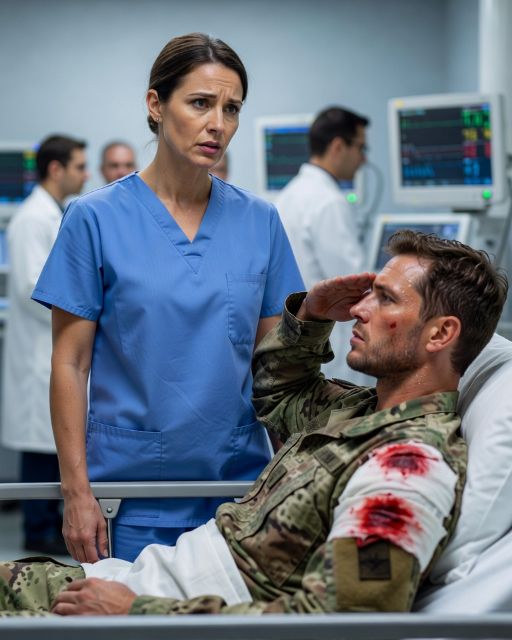
Rigby’s arm moved. Slowly. Shaking. The IV line trembled. He lifted his hand — barely — and pressed it to his forehead in a weak, deliberate salute.
His lips moved. The room was so quiet you could hear the fluorescent lights buzzing.
He whispered: “I know you.”
Jolene stopped.
Everyone looked at her.
Rigby’s voice cracked. “Bastion. 2019. You pulled me out of a vehicle that was on fire.”
Jolene’s face didn’t change. She just nodded once.
Rigby kept his hand up, shaking, refusing to drop the salute.
Dr. Kemper set down his instruments. Vince stared at the floor. The scrub tech near the back door quietly left the room.
But what nobody in that OR knew — what wouldn’t come out until three days later, when Colonel Jeffords called an emergency meeting with the hospital’s surgical staff — was what was in Jolene’s service file. The one she’d asked to have sealed.
Because it didn’t just contain commendations.
It contained the real reason she’d been transferred to Womack. And when Kemper finally read it, he sat down in his chair, put his head in his hands, and said to no one in particular:
“She wasn’t sent here to learn from us. She was sent here because we needed to learn from her.”
The conference room was cold and sterile, just like the OR. Dr. Kemper sat at the head of the table, flanked by the senior surgical staff. Vince stood against the back wall, looking like he wished it would swallow him whole.
Colonel Jeffords stood at the front, a thin file in his hand. Jolene was not present. She had specifically asked not to be.
“For the past six months,” Jeffords began, his voice low and even, “this department has had an eighteen percent increase in what the Army Medical Command classifies as ‘adverse patient safety events.’”
He let that sink in.
“That’s a bureaucratic way of saying we’ve been making mistakes. Preventable ones.”
He looked directly at Kemper.
“Three months ago, we lost a patient from a post-op infection traced back to a breach in sterile protocol. Last month, a misread on a pre-op scan led to a six-hour exploratory surgery that should have taken ninety minutes.”
“These were good people, good doctors,” Jeffords continued. “But they got comfortable. Complacent.”
“Womack is a top-tier facility. We have the best equipment, the best funding, the best of everything. And that has become our greatest weakness.”
A murmur went through the room.
“You’ve forgotten what it’s like to work with nothing. You’ve forgotten how to rely on your eyes, your hands, your gut. You rely on the machine to tell you when a patient is crashing, instead of seeing it in their skin color three minutes earlier.”
He tapped the file.
“That’s why Nurse Prideaux is here.”
“Her file is full of commendations for bravery under fire. That’s true. But it also contains a series of after-action reports she wrote. Not about the enemy, but about us. About our own medical teams in the field.”
Jeffords opened the file and read a single line. “‘The most dangerous thing in a trauma bay isn’t the injury; it’s the assumption that you know what you’re doing.’”
He closed it.
“Jolene Prideaux was sent here on a ‘quiet professional’ assignment. Her job was to integrate, observe, and report back on the institutional arrogance she saw developing in our stateside facilities. She wasn’t a trainee. She was your auditor.”
The silence in the room was absolute.
Kemper looked down at his own hands. The hands of the best trauma surgeon on the east coast. The same hands that had frozen over Captain Rigby.
Vince slid down the wall and sat in a chair, his face pale. He’d mocked an auditor. A living legend from the field.
“The events in OR 4 three days ago confirmed everything she had noted in her first ten days here,” Jeffords said, his voice hard. “Egos overrode training. Mockery replaced teamwork. And a good man almost died because of it.”
“Dr. Kemper, you froze. Vince, you were making jokes. And Nurse Prideaux, with her hands shaking from what I now know is residual nerve damage from a shrapnel wound… she was the only one in the room actually doing her job.”
That detail landed like a physical blow. Her hands didn’t shake from nerves. They shook from an injury she’d sustained while saving someone else.
“She saved that man’s life twice,” Jeffords finished. “Once in Bastion, and once in your own operating room. I suggest you all think long and hard about that.”
He left the file on the table and walked out, leaving a room full of the Army’s best medical minds in stunned, shamed silence.
The next few days were awkward.
People avoided Jolene’s eyes. Conversations stopped when she entered the break room. Vince actively changed his schedule to avoid being on the same shift.
Jolene just kept her head down and did her work. She restocked supply closets. She checked vitals. She held the hands of soldiers’ wives in the waiting room.
She never mentioned the incident in the OR. She never mentioned the meeting with Jeffords.
It was Kemper who finally broke the ice.
He found her late one night in the deserted cafeteria, stirring a cup of tea, her gaze lost somewhere in the polished linoleum floor.
“Can I sit?” he asked. His voice was hoarse.
She nodded.
He sat down across from her. For a full minute, he just looked at his own reflection in the dark window.
“I read your file,” he said finally. “The whole thing. Not just the summary Jeffords had.”
Jolene didn’t look up. “It’s not that interesting.”
“Isn’t it?” Kemper’s voice was heavy with regret. “It says you performed a field amputation with a standard issue multi-tool and a roll of gauze. It says you kept three blast victims alive for seven hours with one bag of saline and a series of tourniquets made from their own uniforms.”
He paused. “It says you were awarded the Silver Star after you shielded a wounded corpsman with your own body during a mortar attack. That’s where you got the… the shrapnel.”
She finally looked at him. Her eyes weren’t angry. They were just tired.
“We did what we had to do, sir. Everyone did.”
“No,” Kemper said, shaking his head. “We don’t. Not here. We’ve got every tool imaginable, and we forget the most important one. Listening.”
“I didn’t listen to you,” he admitted. “I looked at you, and I saw a quiet, nervous, young nurse. I didn’t see a hero. And I am so, so sorry.”
The apology hung in the air between them. It was genuine. Heartfelt.
“I’m not a hero, Doctor,” she said softly. “I’m just a nurse. I just want to make sure everyone gets to go home.”
“Then let me help you,” he said. “Help us. What you did in that OR… it wasn’t just about technique. It was about seeing the whole picture. We’ve lost that. Teach us.”
This was the twist Jolene hadn’t seen coming. She came here to observe a problem. She never expected to be asked to solve it.
“I don’t know how to teach,” she said.
“Just do what you do,” Kemper replied. “We’ll watch. And this time, we’ll listen.”
The change wasn’t immediate, but it was real.
It started with small things. Kemper began his morning rounds by asking Jolene what she’d observed overnight. Vince started asking her opinion on instrument trays for complex procedures. The jokes and the whispers stopped. They were replaced by quiet questions.
Then came the second crisis.
A Black Hawk helicopter had a hard landing during a training exercise. The call came in: multiple casualties, inbound. The ER exploded into organized chaos.
Jolene was assigned to Trauma Bay 2 with Kemper and his team. Vince was the scrub tech.
The patient was a young pilot, barely twenty, pinned by the console. He was losing blood fast from a crushed pelvis and a suspected aortic tear. He was crashing as they wheeled him in.
The old Kemper would have started yelling for scans, for diagnostics, for a dozen different specialists.
The new Kemper just looked at Jolene. “What do you see?”
Jolene’s eyes scanned the pilot from head to toe. Not the monitors. The patient.
“His left leg is colder than his right,” she said, her gloved hand brushing his skin. “No pedal pulse. The tear isn’t in his chest. It’s lower. Abdominal aorta, just above the bifurcation. We don’t have time for a scan.”
She looked at Kemper. “You have to open him up right now.”
Vince already had the laparotomy tray ready. He’d anticipated it. He placed a scalpel in Kemper’s hand. Their eyes met for a fraction of a second. It was a look of trust.
“Let’s go,” Kemper said.
The surgery was a brutal, desperate race against time. The aorta was torn, just as Jolene had predicted. Kemper’s hands flew, clamping, suturing, fighting the tide of blood.
But this time, he wasn’t alone.
Jolene was a step ahead of him the entire way. She was calling out for blood products before the anesthesiologist even saw the pressure drop. She was positioning retractors to give him a better view without being asked. She and Vince moved around each other with an unspoken rhythm, a seamless dance of competence.
There was no ego in the room. There was no mockery. There was only a team. A single unit with one purpose: to get this soldier home.
Two hours later, the pilot was stable. He was alive.
As they were closing, Kemper looked across the table at Jolene, his mask unable to hide the profound respect in his eyes. “Thank you, Nurse,” he said.
Vince nodded from his station. “Yeah. What he said.”
Jolene just gave a small, tired nod in return.
A week later, Captain Rigby was walking the halls, a cane in his hand and a deep sense of gratitude on his face. He found Jolene in the same deserted cafeteria.
He didn’t salute this time. He just pulled up a chair.
“I never really thanked you,” he said. “For Bastion.”
“You don’t have to,” she said. “I was just doing my job.”
“You pulled me out of a burning truck, Jolene. That’s a little more than ‘doing your job.’ You saved my life then, and you saved it again last week. How do I repay that?”
Jolene thought for a moment, stirring her tea.
“You just did,” she said. “You came back. You got better. That’s the only payment any of us ever wants.”
He smiled. “Fair enough.”
A new protocol was established at Womack, spearheaded by Dr. Kemper. It was called the “Prideaux Protocol.” It was deceptively simple. Before any major trauma procedure, there was a mandatory sixty-second pause. The entire team would stop, look at the patient—not the charts, not the monitors—and everyone, from the senior surgeon to the newest resident, would voice what they saw.
It was a protocol of humility. A protocol of listening.
Jolene was offered a promotion, a teaching position to implement the protocol across other military hospitals.
She respectfully declined.
She didn’t want a desk or a title. She asked to stay right where she was, on the surgical floor. She was most comfortable there, in the quiet moments between chaos, where she could make a real difference.
Her hands still shook sometimes when she held a coffee cup. But in the OR, they were the steadiest hands in the room. The team no longer saw the tremor as a weakness. They saw it for what it was: a scar. A reminder of the price of saving a life, and the quiet strength of the person who was willing to pay it.
True strength isn’t found in a loud voice or a list of accomplishments. It’s found in the quiet competence of a job well done, in the humility to listen, and in the courage to step forward when everyone else freezes. It’s a lesson the team at Womack learned not from a textbook, but from a five-foot-two nurse who had seen the worst of the world and decided her only job was to make it a little bit better, one life at a time.