I have a bank account with nine zeros. It means nothing. Cash cannot buy a single breath.
My girl, Ruth, lay in a cold steel bed for three long years. Three years since the rain, the wet road, and the crash that broke her head and stopped her life. Today, the head doctor told me it was time. Her brain was flat. I had to pull the tubes and let her go.
I stood outside her room. I reached for the brass knob.
“Do not kill her yet.”
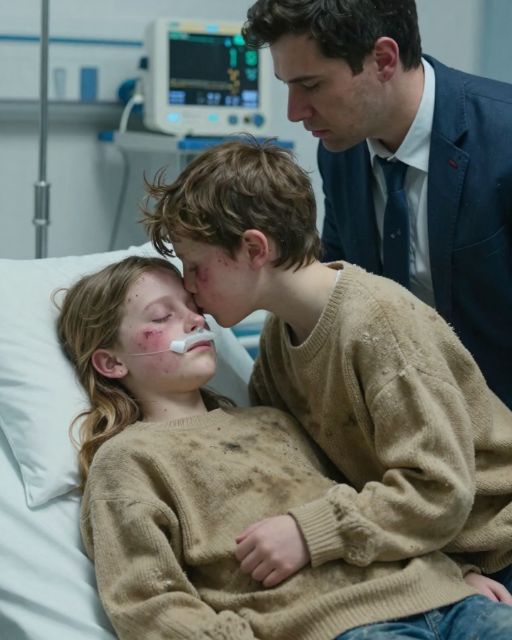
I turned. A boy stood in the hall. He had dirt on his face and smelled like wet street trash. His shoes had holes.
“Get out,” I told him.
“I hide in her room at night to stay warm,” the boy said. His voice was flat. “She squeezed my hand today. She is not dying. She is trying to wake up.”
A sharp ache hit my chest. “You are lying.”
“I am not,” the boy said. “She opened her eyes for one second. She looked at my coat.”
I looked at the thick, green coat on his thin body. It was too big for him. On the left breast was a white patch sewed with black thread: Miller Pipe Work.
My blood turned to ice. I fell to my knees, tears of pure dread spilling down my face.
Three years ago, I drove my heavy truck drunk in the storm. I swerved on the high bridge. I hit a work van and pushed it over the edge into the deep, black river. I drove away. I paid a bad man a lot of cash to clean my truck and wipe the street tapes. The news said the Miller family drowned in the dark water. The cops closed the file.
I stared at the dirty boy. “Who are you?” I choked.
The boy reached into the deep pocket of the green coat. He pulled out a chunk of rusted metal. A silver hood piece shaped like a star.
My hood piece.
“I am the boy who swam out of the back window,” he whispered, stepping close to my face. “I watched my dad sink. I followed your truck plate. I waited three years to find out what room your kid was in. I told the night staff you paid me to sit by her bed.”
He tilted his head, his eyes dead and cold.
“She would have woken up two years ago. But I crushed the white sleep pills into her food tube every single night. I kept her trapped in the dark, just waiting for the very day you had to kill her yourself.”
My world tilted on its axis. The sterile white hallway warped into a tunnel of gray.
The boy’s words were not a shout. They were a whisper, sharp as a shard of glass in my ear.
He did not seem like a boy anymore. He seemed like an old, tired ghost.
A ghost I had made.
My breath came in ragged, useless gasps. I tried to speak, to deny it, but the sound caught in my throat like a fish bone.
He knew. He had always known.
This was not a chance meeting. This was an execution.
“My name is Daniel,” he said, his voice unchanging. “My father’s name was Thomas. My mother, Sarah. They called me Danny.”
The names were hammers against my skull. They were just names in a newspaper clipping I had burned long ago. Now they had a face.
This small, shivering, vengeful face.
“Why?” I finally managed to whisper. The word was dust on my tongue.
“Why?” he repeated, a flicker of something – not surprise, but maybe curiosity – in his dead eyes. “You ask me why?”
He took another step closer. I could smell the river on him, the mud and the cold.
“You took my world. You put it in a metal box and pushed it into the water. I thought it was only fair I keep your world in a box, too.”
He gestured with his chin toward Ruth’s room.
The thought was so monstrous, so perfectly, horribly symmetrical, that I could only stare at him.
The pills. Every night. For two years.
My daughter had been fighting to come back to me. All this time, she had been swimming toward the surface, and this boy, this child I had orphaned, was holding her down.
The rage came then, hot and blinding. It burned away the ice in my veins.
I surged to my feet. I was a big man. He was a scrap of a thing.
My hands clenched into fists. I could end this. I could silence him forever. Another secret my money could bury.
“Go on,” Daniel said, seeing the change in me. He did not flinch. He did not even blink. “Do it. Be the monster again. It’s what you’re good at.”
His courage, his absolute lack of fear, broke me.
My fists unclenched. The rage drained away, leaving only a hollow, echoing shame.
He was right. I was the monster. He was just the reflection in the mirror.
I stumbled back against the wall, sliding down to the floor again. I covered my face with my hands.
“What do you want?” I sobbed. “Money? I will give you everything.”
A dry, crackling sound came from him. It was a laugh, but it had no joy in it. It was the sound of dead leaves skittering across pavement.
“Your money is poison,” he said. “It’s the same poison that let you drive away. The same poison that cleaned your truck. I don’t want it.”
“Then what?” I begged, looking up at him through my tears. “What do you want from me?”
“I wanted you to do it,” he said softly. “I wanted you to walk into that room, tell the doctors to turn off the machines, and sign the papers. I wanted you to kill the last piece of your own heart.”
He paused, letting the horror of it sink in.
“And then, after you did it, I was going to give you this.” He held up the rusted hood ornament. “I was going to tell you that she could have woken up. I wanted you to live with that. Live with it every day until you couldn’t stand it anymore.”
It was the most perfect revenge I had ever heard of. A revenge built not of violence, but of pure, psychological torment.
A footstep echoed down the hall. A nurse, clipboard in hand, was approaching.
Daniel’s eyes darted toward her, then back to me. A flicker of panic. His perfect plan was unraveling.
He had not counted on telling me beforehand. The words had just spilled out of him. Maybe three years of silence was too much for even him to bear.
“Get up,” he hissed, his voice urgent. “Get up!”
I was frozen. My mind was a wreck.
The nurse was closer now. “Mr. Harrison? Is everything alright?”
Daniel grabbed my arm. His grip was surprisingly strong, wiry and desperate. He pulled me to my feet.
“He’s just emotional,” Daniel said to the nurse, his voice suddenly changing. It was the voice of a concerned, helpful child. “Today’s a hard day for him.”
The nurse gave me a sympathetic look. “Of course. I understand. Just let us know if you need anything.”
She smiled kindly at Daniel. “It’s good that you’re here for him. It’s good she has someone who visits so often.”
She continued down the hall, oblivious.
The moment she was gone, Daniel let go of me. We stood there in the silent corridor, two enemies bound by a terrible secret.
“This changes nothing,” he whispered fiercely.
“It changes everything,” I said, my voice finally finding some strength. “You told me. Your plan is ruined.”
“You still have to decide,” he shot back. “She’s still in there. Her brain is still flat. The doctors are still waiting.”
He was right. The horrible choice was still mine.
But now there was a variable. A tiny, impossible splinter of hope.
“You said she squeezed your hand,” I said, grabbing onto the lie he had told me. “You said she opened her eyes.”
“I was lying,” he spat. “I told you. I needed you to listen.”
“Were you?” I pressed, stepping toward him, toward the room. “Were you lying about all of it? Or did you see something? Something that made you wait? Something that made you come find me today?”
He said nothing. His face was a mask of cold fury, but I saw a crack in it. A tiny tremor of doubt in his jaw.
“Let’s go inside,” I said, my hand on the brass doorknob.
I turned it and pushed the door open.
The room was dim, filled with the quiet, rhythmic sounds of machines. Ruth was a pale shape in the bed, a tangle of tubes and wires connecting her to a life that wasn’t hers.
Daniel followed me in. He stood by the door as I walked to her bedside.
I took her hand. It was cool and limp. I had held it a thousand times over three years, praying for a sign, a twitch, a flicker. Nothing.
“She’s gone,” I whispered, more to myself than to him. The doctors were right.
“They said that a year ago,” Daniel’s voice came from the shadows. “They said it two years ago. Doctors don’t know everything.”
I looked at him. He had moved to the foot of the bed. He was staring at Ruth, and for the first time, his expression was not cold. It was something else. Complicated.
“Why do you stay here?” I asked him. “Hiding in her room at night. You could have gone anywhere.”
He shrugged, pulling the oversized coat tighter around himself. “It’s warm. Nobody bothers me.”
“That’s not it,” I said.
He was silent for a long time. The only sound was the gentle hiss and beep of the monitors.
“She looks like my mother,” he finally said, his voice so quiet I almost didn’t hear it. “When she’s sleeping. She has the same… quiet.”
The confession hung in the air between us.
This room had not just been a place for his revenge. It had been his sanctuary. A place where he could watch a girl who looked like his dead mother, a girl kept alive by the man who had killed her. The psychology of it was twisted and heartbreaking.
He was not a monster. He was a broken child trying to make sense of a broken world.
“Daniel,” I began, my voice thick with emotion. “What I did…”
“Don’t,” he cut me off. “Don’t say you’re sorry. A word doesn’t bring my father back. It doesn’t teach me how to drive a car or fix a pipe like he was going to.”
He walked over to the IV stand, to the tube that carried nutrients into my daughter’s body. He pointed to a small port.
“This is where it goes,” he said. “The pills. I crush them into dust with a rock I keep in my pocket. Mix it with a little water from the fountain down the hall. Every night. Just a little. Enough to keep her dreaming.”
My gaze followed his finger. To see the method so plainly, to understand the cold mechanics of his revenge, was devastating.
He had been playing God. And because of me, he had the right.
“Stop,” I said. It was all I could say.
“Why should I?” he challenged me, his eyes flaring. “You didn’t stop. You didn’t stop your truck. You didn’t stop to see who was in the water. You just drove away and paid a man to make it all disappear.”
Every word was true. Every word was a nail in my coffin.
I looked from Daniel’s angry, grieving face to my daughter’s peaceful one.
One was trapped in a nightmare of the past. The other was trapped in a dream she couldn’t wake from. And I was the jailer for them both.
“You’re right,” I said, my voice clear and steady for the first time. “I was a coward. I ran. I hid behind my money because I couldn’t face what I had done.”
I walked over to the window and looked out at the city lights. I had owned so much of that skyline. It meant nothing now.
“I can’t take back that night, Daniel. I can’t give you your family back. But I can stop running.”
I turned to face him.
“You win,” I said. “You wanted me to live with what I did? You succeeded. I will live with it for the rest of my life. But it’s not going to be a life of hiding anymore.”
I walked to the small table by the bed and picked up the phone.
Daniel watched me, his expression wary. “What are you doing?”
I dialed a number I knew by heart. My lawyer.
“Robert,” I said when he answered. “I need you to call Detective Morris at the precinct. I need you to tell him I’m ready to make a full confession about the Miller family accident on the bridge three years ago.”
I could hear the sputtering protest on the other end of the line. I cut him off.
“There is no discussion, Robert. Just do it. I’ll be waiting for them here. At the hospital.”
I hung up the phone.
The silence in the room was absolute. Even the machines seemed to have gone quiet.
Daniel stared at me, his mouth slightly agape. This was not part of his plan. His revenge was about my internal suffering, not about legal justice.
“What did you do?” he whispered.
“What I should have done three years ago,” I replied. “I’m facing the truth.”
I turned back to my daughter’s bed. I looked at her, so still and silent.
“Whether she wakes up or not… is not up to me anymore. Or you.”
I held her hand.
“I’m sorry, Ruth,” I whispered. “I’m so sorry I failed you.”
I felt a presence beside me. It was Daniel.
He was watching my hand holding Ruth’s. He reached into his pocket and pulled out a small, folded piece of paper. It held a fine white powder.
Tonight’s dose.
He looked from the powder to Ruth’s face, then to me. His cold eyes were filled with a terrible, agonizing conflict. His entire identity for three years had been wrapped up in this vengeance. Without it, who was he?
He walked slowly to the small sink in the corner of the room. He unfolded the paper and tipped the powder into the drain. He turned on the faucet and washed the residue away.
He had just let go of the only thing he had left. His hate.
He came back to the bedside. He stood on the other side of Ruth, a mirror image of me.
And then, something happened.
A flicker.
The fingers on the hand I was holding, they moved. Just a tiny, infinitesimal curl.
I froze. Was I imagining it?
I looked at Daniel. His eyes were wide. He had seen it too.
“She… squeezed my hand,” he whispered, echoing the lie he had told me in the hallway.
But this time, it was true.
The monitor above her bed, the one that measured brain activity, had been a flat, green line for years. Now, a small, weak blip appeared. Then another.
A tear rolled down Daniel’s dirty cheek. It was the first sign of the child he had been, the boy who had lost his mother.
We stood there, the murderer and the avenger, on either side of the girl who connected us, and we watched as, slowly, miraculously, she began to swim toward the surface.
The police came. I confessed to everything. I didn’t spare a single detail. The money, the cover-up, the years of guilty silence.
I was sentenced to prison. I lost my company, my fortune, my freedom. I lost everything I thought was important.
And in doing so, I gained everything that was.
Daniel, with the help of a state-appointed lawyer, was placed into a good foster home. He testified at my trial, not with anger, but with a quiet, sad dignity. He told the truth about what I did, and what he did. They called his actions the result of profound trauma. He would not be charged.
He used some of the victim’s compensation fund I had to pay to get a small apartment when he turned eighteen. He started working for a new pipe fitting company. He was learning a trade, just like his father was going to teach him.
Ruth’s recovery was long and arduous. It was a journey of a thousand small steps. A word. A smile. The first time she could sit up on her own.
The first letter I received in prison was not from her. It was from Daniel.
It was a single sheet of paper with a photo enclosed. The photo was of him and Ruth, sitting on a bench in the hospital garden. He had his arm around her, and she was smiling a real, genuine smile.
At the bottom of the letter, he had written just five words.
“She remembers the green coat.”
And I knew.
The story’s theme is that guilt is a prison we build for ourselves, and the only key is truth. Revenge, no matter how justified it feels, only builds another prison next to it. It’s only when we have the courage to face the consequences of our actions, to let go of the hate that consumes us, that we can find true freedom. It is in losing everything that we sometimes find the one thing we truly needed: peace.