But When The Judge Recognized The Medals On My Chest, His Hands Began To Shake As He Whispered One Sentence That Silenced The Entire Room—And My Family—Forever.
The moment I walked in, the entire courtroom fell silent.
Not a respectful silence. A shocked one.
My father, Robert Carter, let out a short, barking chuckle. The sound of it, sharp and mocking, cut right through the stillness.
My mother, Margaret, sitting beside him in her Sunday pearls, didn’t laugh. She just closed her eyes and shook her head slowly, her lips pressed into a thin, white line. It was the same look of profound, bottomless embarrassment she’d worn the day I told her I was enlisting.
Then, I looked at the judge.
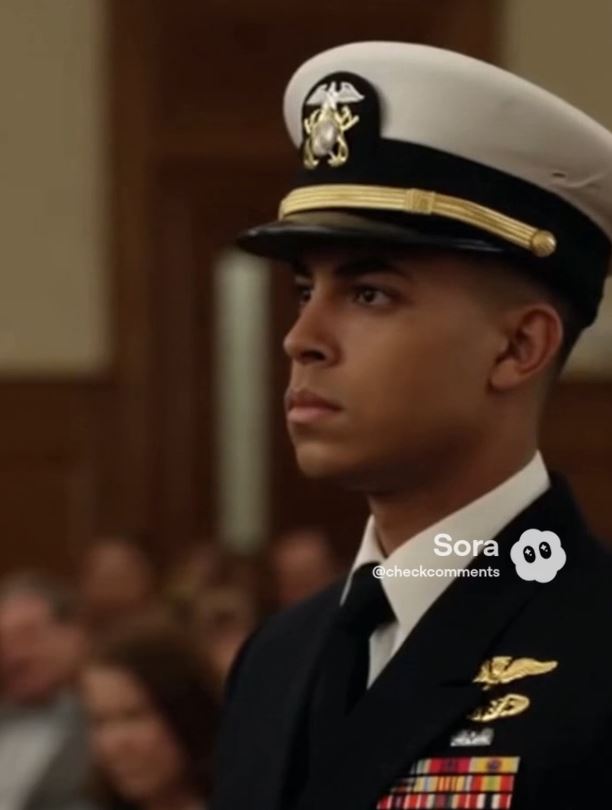
His name was Harold Simmons. An older man, tired eyes, a face that had seen too many families tear each other apart. He froze, his hand halfway to his water glass. He stared at me. Not at me, but at the dark blue wool of my uniform, at the rows of ribbons over my left breast, at the silver Commander’s insignia on my collar.
His hand began to tremble.
He leaned forward, his voice a hoarse whisper that somehow carried across the entire room.
“My God… is that really him?”
Everyone turned. The lawyers, the clerk, the other families waiting for their turn to fight. They all just… stared. Nobody said a word.
That was the first time in my life my parents ever went quiet because of me.
Two days before, I was just a ghost trying to live a quiet life. I was on my knees in the front yard, trying to wrangle the overgrown azaleas. My left knee—the one rebuilt by Navy surgeons with titanium and screws—screamed in protest.
I was sweating under the Virginia sun, my old shepherd mix, Knox, lying in the shade watching me. He was a ghost, too. We both limped. We both knew what it was to come home changed.
That’s when the mail truck pulled up. The carrier handed me the stack. It was all junk, bills, and then… one envelope. It was thick, cream-colored, and heavy. The return address was a seal I knew from a life I’d tried to forget: Portsmouth Family Court.
I ripped it open.
It wasn’t an invitation. It was a summons.
Case #4238B. Carter versus Carter. Petition for property division.
At first, I thought it was a mistake. Then my eyes found the names, and the air left my lungs.
Plaintiffs: Robert and Margaret Carter. Defendant: Evelyn Carter.
My parents. My own mother and father were suing me.
The words blurred. The sound of the cicadas in the trees faded to a high-pitched whine. I laughed. It wasn’t a happy sound. It was the dry, broken laugh of someone who has seen the absolute absurdity of human cruelty and has no tears left for one more drop of it.
Knox limped over, sensing the change in me, and pressed his heavy head against my knee.
“Well, buddy,” I murmured, scratching his ear. “Looks like they finally found a new way to talk to me.”
It had been twelve years since I’d left this town. Twelve years since I’d stood in their kitchen and told them I wasn’t going to college for business. I was enlisting.
My father’s face, stained with grease, had turned a deep, dangerous red. “You’re abandoning this family,” he’d roared.
My mother, as always, just stood by the sink, wringing her hands, her disappointment a silent, suffocating fog.
I served. I wasn’t the kind they make movies about. My job was logistics and emergency extractions. I kept teams alive.
Then came the IED blast near Al-Huda.
A flash of white that erased the world. The shriek of metal. I came home with a rebuilt knee, a limp, and a pension check. I bought a small house near Norfolk and tried to forget that my parents, who lived less than an hour away, never once called to see if I was alive.
And now this. A summons. They wanted the farmhouse. The one thing my grandfather, a WWII Navy man, had left me. The one man who ever told me he was proud of me. They were claiming I “abandoned” it.
That night, I sat at my kitchen table, staring at the summons. Around 0300, I finally moved. I went to the closet and pulled out the old Navy chest.
Inside, beneath a folded flag, was my uniform. My full Dress Blues.
I hadn’t worn it since my best friend’s funeral. My hands trembled as I lifted the jacket out.
I held it up in the dim light. Knox tilted his head, his old eyes questioning.
“Guess they’re finally going to see who I became,” I whispered.
The next morning, I looked at myself in the mirror. The jacket was tight, but it carried the weight of purpose. I stood straighter than I had in years.
I thought about not wearing it. Just going in jeans. Letting them see the broken soldier they thought I was.
No. Not this time.
I adjusted the collar. I whispered to the tired, scarred woman in the mirror.
“Let’s end this. Quietly.”
And now here I stood, in that courtroom, feeling everyone’s eyes on me.
My father coughed, regaining his confidence. “She’s playing dress-up. That’s all this is. Trying to intimidate the court.”
The judge didn’t respond to him.
He kept staring at me, then finally turned to the court clerk. “Clear the room. All nonessential parties.”
There were murmurs, confusion, but he was firm. Within minutes, it was just us: me, my parents, our attorneys, and Judge Simmons.
He leaned back, looked me square in the eye.
“Commander Carter,” he said, his voice steadier now. “I was a junior officer on the USS Bonham in ‘94. I know those ribbons. I know what you’ve done.”
My attorney looked surprised. My parents just stared.
“I read this file,” he said, tapping the folder in front of him. “But nowhere in here did anyone mention your service.”
My father scoffed. “Because it’s irrelevant, Your Honor. She’s trying to use sympathy to hold onto property she hasn’t used or maintained.”
My jaw tightened. But I said nothing.
The judge looked at me. “Do you have anything to say?”
I nodded once. “Only this: my grandfather left that house to me in his will. I have maintained the taxes, utilities, and basic upkeep through a local property manager. I haven’t lived in it because I was deployed. Then I was recovering. I still go there when I can.”
My mother opened her mouth, but the judge held up his hand.
“I served with men like your grandfather,” he said, almost gently. “Men who made it home and made sure their values lived on.”
He stared at my parents now. “And I’ll be damned if I let those values get trampled in my courtroom.”
My father shifted, clearly fuming.
The judge turned to their attorney. “Is there any legal standing that overrides a legally binding will?”
The man swallowed. “Not unless it can be proved she relinquished interest or failed her duties to the property.”
“She didn’t,” I said quietly. “I can produce records.”
The judge nodded. “Then this case is dismissed.”
I blinked. Just like that.
But then he said something else.
“I’m issuing a formal note to the clerk that the defendant’s military service should have been disclosed as material context. This borders on malicious prosecution. If I see anything like this again, I’ll consider sanctions.”
My parents looked stunned.
I didn’t.
I’d seen this kind of power play before. Not on a battlefield, but around kitchen tables, at family barbecues, in the silence of birthdays they never showed up for.
Outside, I stood in the sun. Knox waited in the truck, tail thumping as I climbed in.
I looked one last time at the courthouse doors.
They didn’t follow me out.
I hadn’t expected them to.
But three weeks later, I got another letter. This time, from my father.
It was just a few lines. No apology. Just, “You made your point. We won’t contest the will again. Take care.”
I didn’t write back. I didn’t need to.
Then something strange happened.
The property manager I’d hired called. Said someone had come by to patch the roof. Said they left no bill. Just said, “The place matters. Someone who matters owns it.”
A week later, a box showed up. Inside were photos. Old ones. Me as a kid, on my grandfather’s shoulders. Notes in his handwriting. I hadn’t seen them in years.
My mother must’ve sent them.
I still didn’t reach out.
But something inside softened.
I don’t know if they changed. Maybe they just realized they couldn’t win.
Or maybe, just maybe, they saw me. Really saw me—for the first time.
Here’s what I learned:
Sometimes the people who are supposed to love you the most are the ones who need the biggest wake-up call. Sometimes you have to stand up, not to fight, but just to remind them you’re still standing.
I don’t wear that uniform every day. But the strength it gave me? That I carry always.
And if you’re reading this—if you’ve been cast aside or doubted—don’t shrink to fit someone else’s comfort.
Stand tall. Even if it shakes the room.
Share this if you believe respect must be earned—and that no one should ever have to prove their worth to their own family. ❤️👇