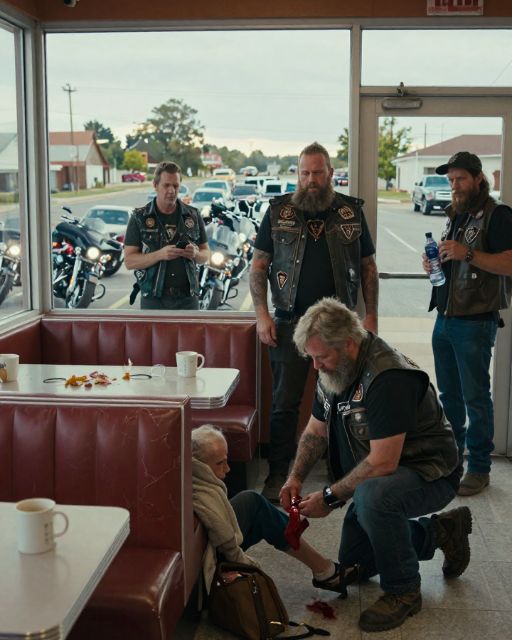
It was super late, quiet. Just me and my bike out on the road. Then I saw her. A lady, big belly, walking real slow, like she was hurting. My gut told me to stop. I asked if she was okay. She looked so tired, said she felt kinda sick, just needed to get to a bathroom fast. There was a dirty old pub down the street. I told her I’d take her there, just hop on. She thanked me, shaky and pale.
I waited outside, by my bike, just watching the pub door. Figured I’d make sure she was alright when she came out. A few minutes later, she walked out, but something felt wrong. She was moving faster, way too fast for someone who just felt sick. She didn’t look back at the pub at all, just hurried away into the night.
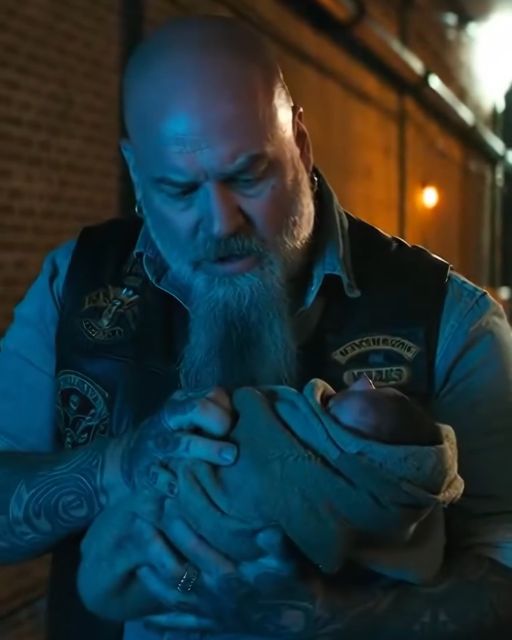
That’s when I noticed it. A tiny sound. Like a little cry. It wasn’t loud, but I heard it. It came from the alley next to the pub. My heart started beating like crazy. I walked over, my feet dragging, thinking “no, it can’t be.” And there, in the dark, tucked in a pile of old shirts, was a tiny bundle. A baby. Still so small, wrapped up tight, just left there in the cold… 😳
My name is Alex. I’m just an ordinary person, trying to get by, working odd jobs, mostly delivering food on my bike late into the night. Finding that baby changed everything. My hands shook as I reached down, terrified I would hurt the fragile little life.
The baby was so small, impossibly small, wrapped in a thin, worn blanket. Its face was scrunched up, a tiny whimper escaping its lips. It felt impossibly cold to the touch. Panic seized me, but then a deeper, primal instinct to protect kicked in.
I scooped up the bundle, holding it carefully against my chest, trying to share my body warmth. The tiny cries grew a little louder, a heartbreaking sound in the stillness of the alley. I knew I had to act fast.
My phone felt heavy in my hand as I fumbled to dial emergency services. My voice was shaky, almost a whisper, as I tried to explain what I had found. The operator’s calm questions barely registered through the ringing in my ears.
They told me an ambulance and police would be there quickly. I stood there, cradling the baby, rocking gently, whispering soft, nonsensical words of comfort. The pub lights seemed too bright, the alley too dark, everything too stark and real.
The baby eventually settled, its tiny body trembling slightly, but its cries softened to small snuffles. I felt a strange mixture of profound sadness and an overwhelming sense of responsibility. This helpless little soul depended on me, a complete stranger.
Within minutes, the wail of sirens pierced the night, growing louder as they approached. A police car and an ambulance pulled up to the pub, their flashing lights casting eerie shadows. Officer Davies was the first to approach, his face grim as I pointed to the spot where I found the baby.
A kind paramedic, Sarah, gently took the baby from my arms, her movements swift and professional. She quickly checked its vitals, murmuring reassurances as she wrapped the tiny infant in a proper thermal blanket. The baby was a girl, she told me, and remarkably, seemed healthy, just very cold.
I answered Officer Davies’ questions, recounting every detail of my encounter with the pregnant woman. I described her appearance, her hurried departure, the quiet cry. He took notes, his expression unreadable. I felt a knot of anger tighten in my stomach, wondering how anyone could do this.
After the ambulance sped off to the hospital, taking the baby with it, Officer Davies asked me to come down to the station to give a formal statement. The alley felt even colder and emptier now, devoid of the tiny presence that had briefly filled it. My bike seemed insignificant.
At the police station, I gave my statement, detailing everything I remembered about the woman. Her height, her pale face, the way she clutched her stomach. I felt a strange emptiness now that the immediate urgency was over, a quiet ache in my chest.
The next few days were a blur of restless sleep and constant worry. I couldn’t stop thinking about the baby girl. Was she okay? What would happen to her? Had they found her mother? Every news report I heard, every siren in the distance, made me jump.
Social services contacted me a day later. Ms. Albright, a gentle but firm woman, wanted to know if I would be willing to stay involved, at least as a witness. She explained the process: the baby, now named Jane Doe by the hospital, was safe and thriving. She would soon be placed in temporary foster care.
I asked if I could visit her. Ms. Albright looked at me with a soft, understanding gaze. “You can,” she said, “but it’s important to understand the boundaries. You’re a witness, Alex, not a guardian.” Still, the permission was a lifeline.
The first time I saw Jane at the hospital, nestled in a small clear bassinet, my heart swelled. She was tiny, perfect, with a little wispy cap of dark hair. She looked so peaceful, completely unaware of the dramatic start to her life.
I spent an hour just watching her, a strange protective feeling washing over me. I felt an undeniable connection to this little person. She stirred once, her tiny hand reaching out, and I instinctively offered my finger for her to grasp. Her grip was surprisingly strong.
Over the next few weeks, I visited Jane almost daily. My odd jobs suddenly felt less important. I’d rush through deliveries just to make it to the hospital during visiting hours, to hold her, to talk to her in soft murmurs. The nurses knew me by name.
Meanwhile, the police investigation continued. They’d canvassed the area, checked CCTV footage, but the woman seemed to vanish into thin air. There were no leads, no one had seen anything suspicious apart from my own encounter. It was incredibly frustrating.
One evening, about a month after I found Jane, Ms. Albright called me. She explained that a potential foster family was ready to take Jane in. My heart sank. I knew this was coming, but it still felt like a blow. I had grown so attached.
I blurted out, “What about me? Could I… could I foster her?” The question surprised even myself. I was single, lived in a small apartment, had an irregular income. It wasn’t exactly ideal.
Ms. Albright paused. “Alex, fostering is a very rigorous process. Background checks, home visits, financial stability. It’s not something we take lightly.” I knew she was right, but I felt a desperate need to try.
I spent the next few months navigating the complex world of social services, filling out endless forms, enduring interviews and home inspections. I got a more stable job at a local diner, saving every penny. It was hard, but the thought of Jane kept me going.
During this time, the police finally caught a break. A woman, named Lena, had been reported missing by her worried sister from a town several hours away, around the same time Jane was found. She was pregnant. The photo her sister provided, though blurry, bore a striking resemblance to the woman I’d seen that night.
Officer Davies told me Lena had a difficult life. She was estranged from her family, moved around a lot, and had recently gotten involved with a dangerous crowd, specifically a local gang known for drug dealing and violence. Her sister, Elara, was beside herself with worry.
This was the first twist. The “sick” woman wasn’t just abandoning a baby; she was a missing person herself, entangled in a far more sinister situation. My heart ached for her, recognizing that her desperation must have been immense.
The police tracked Lena to an abandoned warehouse on the outskirts of town. What they found there was horrifying. Lena had been held captive, severely malnourished, but alive. She had given birth in secret, alone, under duress.
She hadn’t abandoned Jane. She had escaped from her captors, heavily pregnant, managing to make it to the alley where I found Jane. Her plan, desperate and heartbreaking, was to leave her baby where she hoped it would be found, believing it was the only way to save her child from the fate she faced.
She thought her captors were still following her. In her weakened state, she believed she was being watched, and the only way to give Jane a chance was to quickly leave her and lead her pursuers away. She had hoped someone good would find the baby.
My encounter with her was mere moments before she was almost recaptured. She had used the pub as a quick diversion, hoping to buy herself a few precious seconds. She genuinely looked “sick” because she was. She was physically and mentally broken.
Lena was taken to the hospital, both for her physical recovery and for mental health support. The gang members were apprehended shortly after, thanks to the information Lena provided. It was a huge relief, but the weight of her suffering was immense.
I visited Lena in the hospital, not as a witness, but as someone who understood. She was thin, her eyes haunted, but there was a flicker of hope when she learned Jane was safe and healthy. She cried silently as I told her about Jane’s tiny grasp and bright eyes.
She explained everything, how she had fallen in with the wrong crowd, how she had tried to leave, and how they had kept her against her will when they found out about her pregnancy, planning to use the baby for some awful scheme. Leaving Jane was the most painful decision of her life, a desperate act of maternal love.
I told Lena that Jane was with a good foster family for now. I didn’t mention my own fostering application, not wanting to add more pressure to her already fragile state. We just talked, two strangers connected by a tiny life and a terrible night.
Lena slowly began to heal, both physically and emotionally. Her sister, Elara, moved closer to support her. Social services began the delicate process of assessing Lena’s ability to parent Jane. It was a long road.
Meanwhile, my own fostering application progressed. I had moved into a slightly larger apartment, had a steady job, and had completed all the required training. I felt ready, truly ready, to provide a home for a child.
Ms. Albright, seeing my dedication and the bond I had formed with Jane, suggested a different path. Given Lena’s recovery and Elara’s support, and my clear commitment, a unique arrangement might be possible. It was another twist in this unfolding story.
She proposed a form of co-parenting or shared guardianship, with Lena as the biological mother, Elara as a strong support system, and myself as an approved foster parent who had already built a deep connection with Jane. It was unconventional, but it prioritized Jane’s best interests.
This meant I would officially become Jane’s foster parent, but Lena would have structured visits, and once she was fully stable, could regain more parental rights, working collaboratively with me and Elara. It was a chance for Jane to have not just one loving parent, but a whole network.
It was a daunting prospect, but it felt right. Lena, with tearful gratitude, agreed to the arrangement. She wanted Jane to have stability and love, and she trusted me. Elara, seeing the sincerity, also welcomed the plan.
And so, Jane, who had been found abandoned in an alley, came home. Not to an ordinary family, but to one built on a foundation of unlikely circumstances, profound compassion, and unwavering hope. My small apartment transformed into a bustling, joyful space.
Lena continued her recovery, working hard with therapists and slowly rebuilding her life. She was a constant presence in Jane’s life, first through supervised visits, then longer stays, always supported by Elara. There were tough days, filled with lingering trauma and guilt, but she faced them with courage.
I became Alex, the “honorary uncle” and primary caregiver. I learned to change diapers, soothe cries, and navigate sleepless nights. It was messy and beautiful, the most challenging and rewarding experience of my life. Jane thrived, her laughter filling our home.
Our unconventional family worked. We had shared custody, a complex but loving web of relationships. Lena, Elara, and I communicated constantly, making decisions together, always putting Jane first. It wasn’t always easy, but we made it work with patience and mutual respect.
One evening, years later, as I watched Jane, now a bright, curious toddler, play in the park with Lena and Elara, a profound sense of peace washed over me. This little girl, who began her life in such a desolate place, was now surrounded by so much love.
My life, once quiet and predictable, had been irrevocably changed for the better. I hadn’t just found a baby; I had found a purpose, a family, and a depth of love I never knew existed. The act of stopping my bike that late night had set in motion a chain of events that led to something truly miraculous.
This story, Jane’s story, taught me that life’s greatest rewards often come from the most unexpected places. It taught me the power of compassion, the resilience of the human spirit, and how a single act of kindness can ripple out, transforming not just one life, but many. We never truly know the struggles others face, and sometimes, the most desperate actions are born from the deepest love. It reminds us that empathy and a willingness to help, even when inconvenient, can sow seeds of incredible joy and connection, creating a family where none was expected.