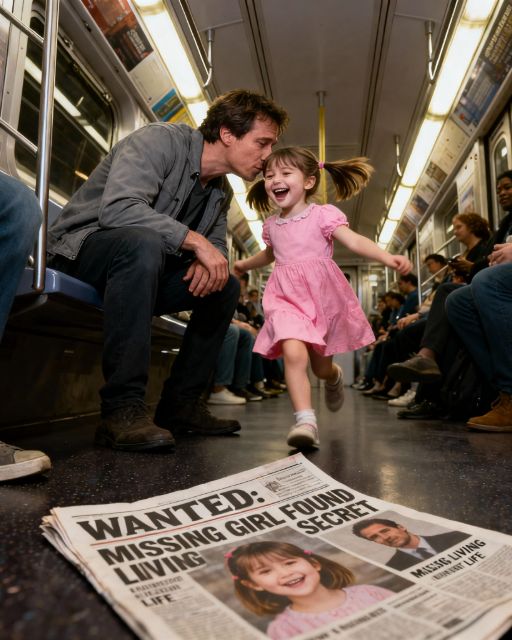
I was on the subway, gripping the pole to keep my balance in the crowded car when a familiar laugh caught my attention. A little girl, no older than five, was skipping around her tired-looking father. The sweetness between them was like a warm embrace, reminding me of my own childhood.
As we approached the next stop, the man leaned down, whispering to his daughter, a smile spreading across her innocent face. My stomach felt light, happiness blooming.
Then, the train jolted abruptly, throwing a newspaper from the man’s lap onto my feet. I picked it up to hand it back and that’s when my blood ran cold.
The front-page headline screamed, “WANTED: MISSING GIRL FOUND LIVING SECRET LIFE,” and staring back at me was the girl’s face beside a different man’s name.
My heart pounded as I realized the date in question. They were talking about today. Right now.
The man in the photo, the one named as the grieving father, was a well-known city developer named Richard Sterling. He looked polished and severe, nothing like the gentle, weary man standing in front of me.
My eyes darted from the newspaper to the girl, Lily, as the paper called her, then to the man whose hand she held so tightly. My mind was a whirlwind of confusion and fear.
Was he a kidnapper? He didn’t look like one. There was no menace in his eyes, only a deep, protective love that I could feel from across the car.
The train doors hissed open. The man scooped the little girl into his arms, and they moved toward the exit.
I had a choice to make, a split-second decision that could change lives. I could scream, point, call the police. I could be a hero.
But something held me back. It was the way he adjusted the little pink bow in her hair, a gesture so tender it ached.
My feet moved before my brain could argue. I followed them off the train and onto the bustling platform, keeping a safe distance.
My hand hovered over my phone, my thumb ready to dial for help. Yet, I hesitated. The story didn’t feel right.
They walked not with the panicked hurry of fugitives, but with the slow, ambling pace of a father and daughter enjoying a day out. He bought her a pretzel from a street vendor, carefully breaking off small pieces for her.
He knelt down to her level, wiping a smear of mustard from her cheek with his thumb. She giggled, a sound pure and untroubled.
I ducked into a doorway, pretending to check my phone, my heart hammering against my ribs. The newspaper article said Richard Sterling was pleading for his daughter’s safe return from a “disturbed family acquaintance.”
This man didn’t look disturbed. He looked tired, yes, and profoundly sad, but not dangerous.
They settled on a bench in a small, crowded park nearby. The girl, Lily, began chasing pigeons while her “captor” watched her with an expression of pure adoration.
I sat on a bench opposite them, hiding behind the newspaper that had started this whole mess. I read the article again, more carefully this time.
It painted a picture of a desperate man, Arthur Cole, a former handyman for the Sterling family with a troubled past. It mentioned a minor criminal record from his youth, painting him as unstable.
The narrative was so convincing, so perfectly crafted. But the reality I was witnessing didn’t match the words on the page.
I watched as Lily ran back to Arthur, her face flushed with excitement. She stumbled, skinning her knee on the pavement.
Before a tear could even form, he was there, scooping her up, his voice a low, soothing murmur. He pulled a small first-aid kit from his worn backpack and carefully applied a cartoon-themed bandage.
She didn’t cry. She just wrapped her small arms around his neck and buried her face in his shoulder, completely secure.
My own father used to do that. He always had a bandage ready, a quiet word to make the hurt go away.
That settled it. My thumb moved away from the emergency number. I couldn’t tear that little girl away from the only comfort she seemed to know.
I folded the newspaper, took a deep breath, and walked toward them. I knew I was taking a massive risk, but my gut screamed louder than my fear.
“That’s a nasty scrape,” I said, trying to sound casual as I approached their bench.
The man, Arthur, stiffened instantly. His arm tightened around Lily, pulling her closer as his eyes scanned me with raw panic. He was ready to run.
“We’re fine,” he said, his voice clipped and wary.
“I know,” I replied softly, holding up my hands in a gesture of peace. “I just… I have some antiseptic wipes in my bag, if you need them.”
His suspicion didn’t fade, but the immediate terror in his eyes lessened slightly. He saw I wasn’t a threat, just a stranger offering a small kindness.
“Thank you, but we’re okay,” he said, his gaze still guarded.
I sat on the far end of the bench, giving them space. I didn’t want to spook them.
“My name is Sarah,” I offered.
He just nodded, his attention fixed on his daughter, who was now examining her new bandage with great interest.
We sat in silence for a few minutes. The sounds of the city park – children laughing, sirens in the distance – filled the air.
Finally, I decided to take the plunge. I slid the folded newspaper across the bench toward him.
His face went pale as he saw the headline. His breath hitched, and he looked like a trapped animal.
“I saw this on the train,” I said, my voice barely a whisper. “And then I saw you. And her.”
He flinched, pulling Lily even closer, as if he could shield her from my words. He looked around wildly, expecting police to swarm the park at any moment.
“Please,” he begged, his voice cracking. “Don’t. She’s all I have.”
His plea wasn’t that of a guilty man. It was the desperate cry of a father terrified of losing his child.
“I haven’t called anyone,” I assured him quickly. “I wanted… I needed to understand. The man in this paper looks nothing like the man I’ve been watching for the last hour.”
He stared at me, his eyes searching my face for any sign of deception. He saw only genuine confusion and, perhaps, a glimmer of empathy.
He let out a long, shuddering breath, the tension leaving his shoulders in a wave of exhaustion.
“He’s her stepfather,” Arthur said, his voice low and heavy with pain. “Her mother, my Clara, she passed away six months ago.”
My heart clenched. The story was starting to unfold, and it was nothing like the one in the papers.
“Clara and I were together for years,” he continued, his eyes distant. “Lily is my daughter. My blood.”
He explained that when he was younger, he’d made a stupid mistake, getting into a fight that led to an assault charge. He did his time, turned his life around, but the record followed him.
Clara had always believed in him, but her family hadn’t. They pushed her toward someone more “stable,” someone with money and influence. That someone was Richard Sterling.
“She married him, thinking it was best for Lily,” Arthur said, a tear tracing a path through the grime on his cheek. “But she never cut me out. I was always ‘Uncle Arthur.’ I saw Lily every weekend. I was her father, in every way that mattered.”
He told me how Richard had always been cold, controlling. After Clara died suddenly from what was called a “sudden aneurysm,” Richard’s behavior grew worse.
He started cutting Arthur’s visits short, then canceling them altogether. He told Arthur that Lily needed to move on, that he was the only father she needed now.
“The last time I saw her,” Arthur’s voice broke, “she had a bruise on her arm. She told me Richard grabbed her too hard because she spilled her juice. She was scared of him.”
That was the breaking point. Arthur knew he couldn’t leave his daughter in that house. He couldn’t go to the police; he was an ex-con, and Richard was a pillar of the community. No one would believe him.
So two days ago, during a supervised visit that he had fought tooth and nail for, he simply walked away with her. He didn’t have a plan, just a desperate need to protect his child.
“I’m not a kidnapper,” he whispered, his eyes pleading with me. “I’m her dad. I’m just her dad.”
I looked at Lily, who had fallen asleep against her father’s chest, her small hand clutching his shirt. I believed him. Every word.
“What can I do?” I asked.
A flicker of hope ignited in Arthur’s tired eyes. He hadn’t expected help. He had only expected judgment and condemnation.
That night, I let them stay in my small apartment. It was a huge risk, but leaving them on the streets was not an option.
While they slept, I went to work. I’m a freelance researcher, and I know how to dig. I started with Clara’s death.
An aneurysm was a plausible cause of death, but something about Arthur’s story nagged at me. It was too convenient for Richard.
I spent hours combing through public records, social media, and old news articles. I found a post from one of Clara’s friends, a bridesmaid from her wedding to Richard, lamenting how much Clara had changed after her marriage, how withdrawn and unhappy she had become.
I found the friend’s contact information and sent a cautious email, explaining I was a writer working on a piece about Richard Sterling’s philanthropy. It was a long shot.
The next morning, while Arthur made Lily pancakes in my tiny kitchen, the smell filling the apartment with a sense of normalcy, my phone buzzed. It was the friend, Katherine. She agreed to talk.
We met at a coffee shop. Katherine was nervous, but she was also angry.
“Richard is a monster,” she said, her hands trembling around her cup. “He isolated Clara from everyone. He was possessive, jealous. She told me she was planning on leaving him, that she was going to go back to Arthur.”
My blood ran cold for the second time in as many days.
“She told you that?” I pressed.
“Yes,” Katherine confirmed. “A week before she died. She said she had been documenting his outbursts, his temper. She kept a journal, a digital one, hidden on a cloud server. She was afraid of what he’d do if he found out she was leaving.”
This was it. This was the twist that could change everything. Clara’s death might not have been an accident at all.
Katherine gave me the login details Clara had shared with her, just in case something ever happened. My fingers flew across my laptop keyboard as I accessed the hidden files.
It was all there. Dozens of entries, photos of bruises she’d hidden with makeup, audio clips of Richard’s terrifying, rage-filled tirades. The final entry was dated the day before she died.
It read: “He found out. I’m telling him tonight that I’m taking Lily and going back to Arthur. God, I hope he understands. I’m so scared.”
She never got the chance. Richard had made sure of it. The aneurysm report was a lie, bought and paid for by a man with the power to bury the truth.
I showed everything to Arthur. He collapsed, sobbing, a storm of grief for the woman he loved and fury at the man who took her from him.
We had the proof, but going to the police was still a gamble. Richard’s influence ran deep. We needed a way to expose him so publicly that he couldn’t possibly escape.
My mind raced, and a plan began to form. Richard Sterling was scheduled to give a speech at a major charity gala that very night. It would be crawling with media.
It was our only shot.
That evening, I dressed in my best clothes, a small microphone and a USB stick containing the journal hidden in my purse. Arthur and Lily stayed with Katherine, who had bravely offered them shelter.
I slipped into the gala, my press pass, a relic from a past internship, getting me through the door. The ballroom was opulent, a sea of wealth and power. In the center of it all was Richard Sterling, smiling, shaking hands, playing the part of the grieving father and benevolent philanthropist. The sight of him made me sick.
When he took the stage, the room fell silent. He began his speech, his voice smooth and practiced. He spoke of community, of charity, and then he paused, his expression turning solemn.
“And as many of you know,” he said, his voice thick with fake emotion, “I am going through a personal tragedy. My beloved daughter, Lily, was taken from me. I only pray for her safe return.”
That was my cue.
I moved to the side of the room, near the audio-visual booth. I’d convinced a young, overworked technician that I had a “special tribute video” for Mr. Sterling that needed to be queued up.
As Richard paused for a moment of feigned sorrow, I gave the tech the signal.
The large screens behind Richard flickered. Instead of the charity’s logo, a photo of Clara appeared, a faint bruise visible on her cheek. Then her voice, taken from one of the audio files, filled the silent ballroom.
“I’m scared of you, Richard. You can’t keep doing this.”
The room erupted in gasps. Richard Sterling’s face turned ashen. He stared at the screen in horror.
Then came his voice, a terrifying, guttural roar from another recording. “You’re my wife! You and the girl, you’re not going anywhere!”
The screen filled with pages from her journal, damning entry after damning entry. The attendees, the media, they all saw it. The truth, in Clara’s own words.
Richard tried to signal for the tech to cut it off, but it was too late. The story was out. The police, whom I had anonymously tipped off to be present, were already moving toward the stage.
His perfect world, built on lies and intimidation, crumbled around him in a matter of seconds.
Weeks later, I sat on that same park bench. The sun was warm on my face.
Across the lawn, Arthur was pushing a squealing Lily on the swings. He looked like a different man. The weariness was gone, replaced by a deep, settled peace.
The courts had moved swiftly. With the evidence from Clara’s journal, Richard Sterling was facing a mountain of charges, including suspicion of murder. Arthur was officially granted full custody of his daughter. His name was cleared, the old record expunged in light of the circumstances. He was no longer a fugitive, just a father.
Lily jumped off the swing and ran toward me, her face a beacon of pure, untroubled joy. She handed me a dandelion she had picked.
“This is for you,” she said with a gap-toothed smile.
Arthur walked over, his eyes full of a gratitude that I could never put a price on. We didn’t need to say much. We had been through something profound together.
As I watched them walk away, hand in hand, I thought about the moment on the subway. I thought about how easy it would have been to trust the headline, to dial a number and ruin their lives based on a story someone else had written.
Life rarely fits into neat little boxes or black-and-white headlines. Sometimes, the truth is messy and hidden, and you can only find it by looking past the surface and listening to the quiet whisper of your own heart. In a world that so often tells us to fear the stranger, sometimes the greatest act of humanity is to offer one a little bit of trust.