
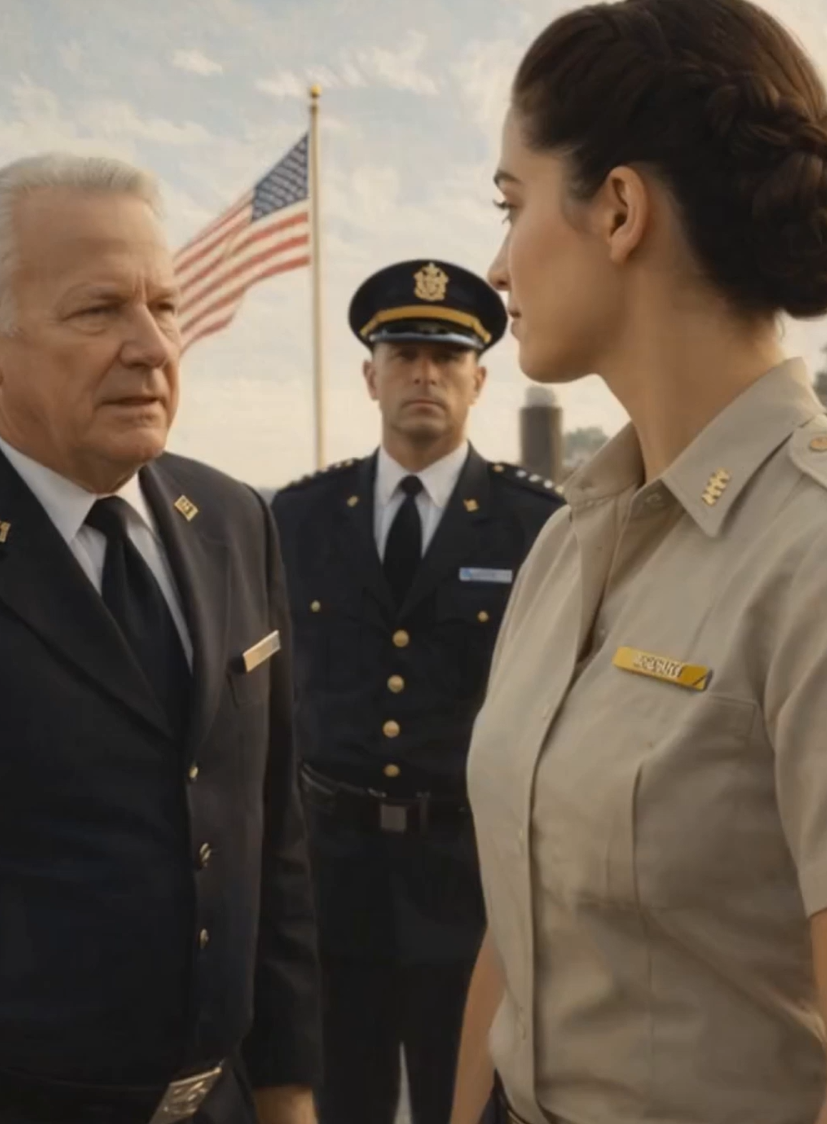
At the Gate on a Memorial Morning
I was working security at the Fleet Week ceremony in Pensacola, a Memorial Day event that drew senators, admirals, and other dignitaries. My post was at the dock entrance. It was a VIP-only section, and I had been briefed to be firm, polite, and unyielding. The instructions were clear, the badges were specific, and the line of important faces stretched out toward the parking lot.
That was when I noticed her. A woman who didn’t look like she belonged in that carefully polished scene. She wore a faded green jacket a size too large, the kind you keep because it holds memories. Her boots were scuffed and sturdy. She moved like someone who had traveled a long way to be there. Her eyes were tired, but focused on the water and the ships beyond the dock.
I stepped forward as she reached my checkpoint. I kept my voice steady and professional. I let the policy lead me, not my instincts. I asked to see her credentials.
She didn’t argue, didn’t protest. She reached into her pocket and handed me a folded invitation that had clearly been carried for some time. The edges were soft and worn. The paper was thin. The official seal looked off to me, not quite what I expected. I had seen dozens of passes that morning. This one looked different.
I made a mistake that still stings to remember. I told her it wasn’t valid. I said she needed to leave.
She accepted my words with a quiet nod, as if she had known they might be coming. She turned around and started back toward the parking lot. Shoulders slightly hunched. Hands buried deep in her pockets. She did not cause a scene. She did not even ask me to take a second look.
The Ceremony Begins
Not far behind me stood a row of dignitaries and their guests. Some had watched the brief exchange and murmured to one another, the way people do when they see a boundary enforced and assume it was necessary. One person shook her head in disapproval. Someone else raised a phone as the woman walked away, saying it was for records. I told myself I had followed the rules. Still, something about it felt wrong, like a pebble caught in my shoe.
Twenty minutes later, the program began. Admiral Richardson took the podium, his uniform crisp and measured, his voice strong and steady over the water. He began reading the names of those who had fallen. It was a solemn roll call meant to stop the day in its tracks and remind us why we were there.
Halfway through, the Admiral paused. A stillness fell over the crowd. His attention had shifted to the far edge of the parking lot.
I followed his gaze. There, near a beat-up Honda Civic, was the same woman in the green jacket. She hadn’t driven away. She stood quietly, looking past us toward the destroyer at the dock, her face lifted to the sight of the harbor as if she were searching for a familiar light.
The Admiral set down his papers and left the podium without a word. Every head turned. Security tensed. I felt my heart climb into my throat. I wondered what I had missed.
Four Stars and a Tattoo
Admiral Richardson walked straight toward her with a purposeful stride, like a man who has recognized something the rest of us could not see. He stopped in front of her and glanced at her wrist. Her sleeve had slipped back just enough to reveal a tattoo in simple black ink. From where I stood, I could make out numbers. Coordinates.
He placed a hand over his heart, as if bracing himself. He spoke to her softly, words I could not hear. I watched her face as the conversation unfolded in a quiet corner of the parking lot. Her expression trembled, then gave way, and tears spilled down her cheeks.
Then the Admiral did something I will never forget. He reached into his uniform and brought out a medal that had been prepared for presentation later in the ceremony. He didn’t pin it to his coat. He held it carefully, and for a moment he just looked at it. Then, slowly, he removed his jacket and placed it over her shoulders. Four stars shone on the epaulets.
The whisper in the crowd died away. Even the water seemed quiet, the way a room grows still when someone tells you what matters most. The Admiral turned and faced us, his voice carrying clear and unmistakable across the dock. He said that the woman in the green jacket had more right to be there than any of us.
I felt my stomach drop. I knew, even before he spoke her name, that I had failed her in a way that uniforms and rules cannot explain away.
He told the assembled crowd that her brother was Petty Officer Second Class Marcus Chen. In 2019, during a fire in an engine room, Marcus had pulled six men out of smoke and flame. The Admiral’s voice caught. He told us he was one of those six.
A Name Becomes a Story
The Admiral guided her back to the seating area, not to the back, but to the front row, to an open chair intended for an honored guest. He made sure she was settled, his own jacket still around her shoulders. Then he returned to the podium, looked down at the pages he had set aside, and chose not to read from them. He looked at her instead. He asked us to listen not to a list of names, but to one story.
He told us about Marcus. He was the brother who could fix almost anything with two tools and a calm smile. He told terrible jokes on purpose, just to make people groan and then laugh a second later. He wrote to his sister, Sarah, every week, even when he couldn’t say much about where he was or what he was doing. He made a habit of staying in touch, of reminding the people he loved that he loved them.
The Admiral described the fire in the engine room, the alarms, the heat, the smoke so thick you could not see your own hands. He spoke quietly, like a man who still remembered the shape of the dark. The order had been given to abandon the space. The hatches were compromised. It was time to go. But Marcus did not go. He went back. He went back into the heat again and again.
Six times, he returned carrying a man over his shoulder. On the seventh trip, he did not come back.
There was no sound on the dock. People stared at the water or down at their hands. Some closed their eyes. A quiet, heavy understanding settled over us, the kind that comes when a distant name suddenly becomes a life, a voice, a face.
The Admiral looked at Sarah and told us plainly that sacrifice does not always arrive in a motorcade or wear a thousand-dollar suit. Sometimes it comes in scuffed boots and a jacket that has weathered many seasons. Sometimes it stands quietly at the edge of a parking lot, hoping to be near the water one more time.
He introduced her to us, not as a stranger who had tried to get by security, but as Sarah Chen, sister of Marcus, a woman who carries his memory every day. He held up the medal he had brought from the podium and said the Navy had been trying to reach the Chen family for two years to present it. He smiled gently and said it seemed she had found them first.
The Weight of an Apology
When the ceremony ended, it did not end with applause. It ended with a reverent silence, the kind that asks you to walk a little slower and speak a little softer. People began to drift away in ones and twos. Their eyes looked different than when they had arrived.
I remained at my post, my own words echoing back at me. I had called her invitation a fake. I had told her to leave. Shame is a heavy thing when it lands where it should. I could feel it settle behind my ribs.
I waited until the crowd had thinned to a few officials offering their quiet condolences. Then I stepped forward, trying to steady my voice. I addressed the Admiral, and then I looked at Sarah. I told her I had no excuse. I told her I was deeply sorry. I said the words that needed saying.
Sarah lifted her gaze. Her eyes were red-rimmed, but clear. There was no anger there, only an old kind of sadness that seems to know its way through the heart. She told me I had been doing my job.
The Admiral, standing beside her, spoke gently but firmly. He reminded me that my job was to protect the event, yes, but that the most important person present was the one I had turned away. The lesson was simple and hard at the same time.
He asked me why I thought her invitation was not valid. I told him exactly what I had seen. The paper seemed wrong. The seal did not look embossed. It did not fit the official standards I had been trained to recognize.
The Admiral reached into his pocket and produced a small folded note. He handed it to Sarah, and she offered it to me. I opened it and saw not a formal invitation, but a handwritten message on plain stationery. It said, in essence, that Marcus was being honored this year and that she deserved to be there. It was signed by Dave, with a small hand-drawn anchor beneath his name.
The Admiral explained softly that Dave was Gunnery Sergeant Dave Miller, the fourth man Marcus had pulled from the fire. He was stationed far from home but wrote to Sarah each month. He had promised to make sure she could attend. When the official channels failed, he sent her his own personal guest pass, written by hand. That note was the credential.
I felt something shift inside me at that simple, quiet truth. I had been trained to look for official stamps and exact matches, the signs of bureaucracy. But what is more official than a survivor who owes his life to a sailor’s courage, putting his promise in ink and keeping it? I had looked right past the only mark that mattered.
I asked Sarah why she had not said more, why she had not told me who she was. She said she wasn’t used to people listening. She did not want to cause a scene. Marcus, she told me, never liked being the center of attention. It didn’t feel right to use his name like a key. All she had wanted was to be near the water and the ship, to feel close to him for a little while.
A Public Promise
As we stood there, Senator Bradford and his wife approached with careful expressions. Their aide hovered just behind them, her phone lowered, her eyes troubled. The Senator offered condolences and words about American heroes. Sarah inclined her head but did not take his hand.
The Admiral’s face was set. He did not soften the truth. He spoke clearly about what families like the Chens face after the ceremonies end and the uniforms are hung up for the evening. He told the Senator that Marcus’s parents had passed the year before, their savings spent on medical bills. He said that Sarah was working two jobs and trying to hold on to the family home. He called our so-called support system for Gold Star families what it often is: a patchwork of charities and promises that fray under pressure.
Then the Admiral reminded the Senator of a bill that had died in committee the previous spring, the Hero’s Promise Act. It would have provided direct support to families like Sarah’s. The committee that had stalled it was the Senator’s own. In the hush that followed, even the gulls seemed to quiet down. There are times when the facts are their own kind of ceremony.
The Senator began with the usual words about budgets and complexities. The Admiral stopped him gently but firmly. Money is always complicated, he said, but a promise should not be. We leave no one behind on the battlefield. That promise must reach the families back home, too.
There was a long silence. Then the Senator did what he should have done earlier. He agreed. He said he would reintroduce the bill and asked that it be named the Marcus Chen Hero’s Promise Act. He looked at Sarah and, perhaps for the first time that day, his eyes held something like genuine regret.
The aide who had taken the photo stepped forward. Her voice shook as she apologized. She showed Sarah the image she had captured while Sarah walked away alone. Then she deleted it. Sarah watched her hand, then nodded once. It was a small moment, but it felt like a thread being set right.
Choosing What Comes Next
When the crowd had fully dispersed, the Admiral rested a hand on my shoulder. He told me what matters is what we do after we make a mistake. The words were not dramatic. They were steady, the way a compass needle is steady.
I went home and thought about uniforms and rules, about paper stock and seals, about what it means to protect something worthy. I thought about the coordinates on Sarah’s wrist and the way the Admiral’s jacket looked around her shoulders. The next day, I submitted my resignation. In my letter, I explained that I could not keep doing a job that taught me to judge a person’s clothes before I understood their character.
Not long after, I took a position at a local VFW post. The work was simple in description but important in practice: helping veterans and their families find their way through forms and offices and phone calls, guiding them to the help they had earned. It didn’t pay as well. It didn’t come with a crisp uniform. But I slept better. For the first time, I felt like I was keeping a different kind of perimeter—the kind that keeps good people from falling through the cracks.
Months passed. The Marcus Chen Hero’s Promise Act came before the legislature again, and this time it moved. It gathered support from both sides of the aisle, and it passed with strength. When the bill was signed, I saw a familiar face on the news. Sarah was there, standing beside the President, wearing a simple blue dress. The Navy Cross was pinned over her heart. She looked peaceful in a way I hadn’t seen at the dock, as if the waters that had been so rough were, for the moment, calm.
The Lesson I Carry
People often think honor is loud. They imagine speeches, uniforms, polished shoes, and grand gestures. There is room for those, of course. But the kind of honor that lingers, the kind that changes how you live, is usually quiet. It is found in a crumpled handwritten note that carries a promise. It is inked into a small tattoo of numbers that point to a place in the sea. It sits in the careful way a sister holds a medal against the fabric of her dress.
That day on the dock, I learned that the measure of a person is never a paper seal or a sharp crease in a sleeve. It is not a last name that opens doors. It is not the car they drive or the suit they wear. The measure of a person is found in what—and whom—they carry with them, in the promises they keep, and in the love that draws them to the water on Memorial Day because that is where their memories live.
I also learned that institutions are only as good as the people who refuse to let their promises fade. An Admiral who will leave a podium to meet a grieving sister where she stands. A survivor who will write a note when the system falls short. A Senator who will finally do the right thing, even if it took too long. And a guard who will admit he was wrong and try to be better.
We cannot change the past. We cannot make a different choice at the gate. But we can change what we look for the next time. We can choose to see the person first. We can invite the quiet forms of courage to step forward and take their rightful place. We can decide, each in our own small way, to keep faith with those who have given us more than we can ever return.
When I think back to that morning, I picture the harbor at Pensacola, sunlight on the water, the shadow of a warship stretching long across the dock. I see a woman in a green jacket, shoulders wrapped in four stars, standing very still as the breeze comes in off the bay. I hear a voice at a podium saying a name not as a line on a program, but as a life worth knowing. And I remember the simple truth that took me far too long to learn: if you really want to honor the fallen, start by honoring the living who carry their memory.
That is the promise I try to keep. It is not complicated. It is not grand. But it is steady, the way a compass is steady, pointing me, again and again, toward what matters most.