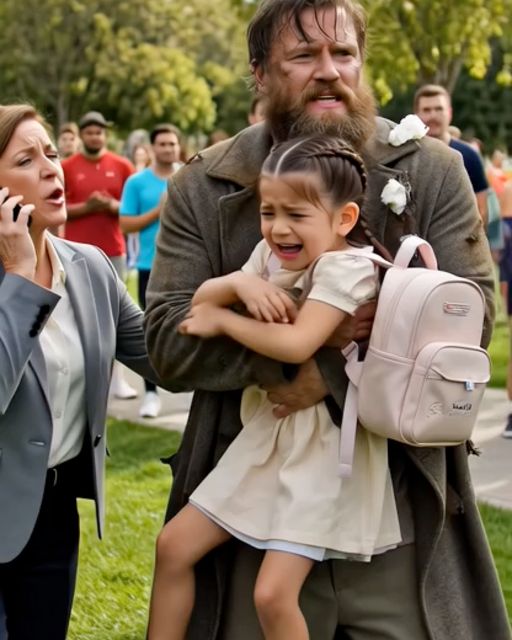
The social worker tried to forcibly remove the crying three-year-old from the “homeless man’s” arms in the park, and the toddler screamed like she was being murdered.
“This child is in danger!” the social worker shrieked, yanking at the little girl’s arm while calling 911.
The man – filthy, bearded, wearing torn clothes and reeking of garbage – held the screaming child protectively, backing away from the crowd of concerned joggers forming around them.
“I’m her father,” he kept saying, but nobody believed him.
Why would they? He looked like he hadn’t showered in months.
The little girl was wearing clean clothes, had a new backpack, perfect hair in braids. She didn’t match this man at all.
“Daddy! DADDY!” she wailed as the social worker finally pried her loose.
Then a motorcycle roared into the park, jumping the curb, tearing across the grass.
The rider didn’t even kill the engine. She leapt off, ripped off her helmet, and screamed five words that made everyone freeze:
“THAT’S MY HUSBAND, YOU IDIOTS!”
She was stunning. Designer clothes, perfect makeup, a diamond ring the size of a marble.
She ran to the “homeless man” and threw her arms around him, sobbing into his filthy chest.
“The experiment is over, Jake,” she cried. “Please. Come home. You proved your point.”
The social worker looked confused. “Experiment?”
The woman turned, tears streaming. “My husband is a billionaire. He spent six months living on the streets to expose how society treats the homeless.”
She looked at the crowd. “Every single day, he walked our daughter to preschool. Nobody ever stopped him when he was in a suit. But the second he looked like this…”
She gestured at his appearance.
“You called the cops seventeen times in three weeks.”
The homeless man – Jake – finally spoke, his voice clear and educated. “Same father. Same love. Same gentle hands. But a different costume.”
He looked at his daughter, now clinging to both parents.
“I wanted to show Emma that appearance means nothing. That the scary-looking man might be the safest person in the room.”
The social worker went pale. The joggers started backing away.
Jake’s wife pulled out her phone. “And we filmed everything. Every hateful comment. Every assumption. Every time someone tried to ‘save’ our daughter from her own father.”
She looked directly at the social worker. “Including you forcibly removing a child from her legal guardian without any evidence of harm.”
The social worker stammered, “I… I was trying to help…”
“You were trying to judge,” Jake said quietly.
Then he reached into his tattered coat and pulled out a leather wallet. Inside was an ID card.
Not for Jake Reynolds, homeless man.
For Dr. Jacob Reynolds, PhD in Social Psychology, Professor at Stanford, founder of the Reynolds Foundation for Human Dignity.
The name of the foundation hung in the air, a stark contrast to the scene.
Sirens wailed in the distance, getting closer. The social worker’s 911 call was finally being answered.
Jake’s wife, Amelia, didn’t flinch. She just held Jake and their daughter, Emma, tighter.
Two police cars screeched to a halt on the park’s edge. Officers spilled out, hands cautiously near their weapons, their faces grim.
“We got a call about a possible kidnapping,” the lead officer said, his eyes fixed on Jake.
The social worker, finding her voice, pointed a trembling finger. “That man! He had this child!”
Jake calmly stepped forward, holding up his wallet. “Officer, I am Dr. Jacob Reynolds. This is my daughter, Emma, and my wife, Amelia.”
The officer took the ID, his expression skeptical. He squinted at the photo, then back at the disheveled man in front of him.
“This says you’re a professor at Stanford.”
“I am,” Jake confirmed. “I’ve been conducting a long-term field study.”
Amelia stepped up, her phone still in hand. “And we have six months of footage to prove it, officer. Along with our daughter’s birth certificate in my car, which is parked right over there.”
She pointed to a sleek, black sedan that looked completely out of place next to the jogging path.
The officer’s demeanor shifted. He handed the ID back, a flicker of understanding, and perhaps embarrassment, in his eyes.
He turned to the social worker. “Ma’am, what’s your name?”
“Brenda Albright,” she said, her voice small. “I work for Child Protective Services. I thought… he looked…”
“You thought he looked poor,” Amelia finished for her, her voice sharp as glass.
The crowd of joggers had mostly melted away, whispering into their phones, no doubt spreading the bizarre story.
Jake knelt to be eye-level with his daughter, who was now quietly sniffling in her mother’s arms.
“Hey, pumpkin,” he said softly, his voice full of a tenderness that no one would have expected minutes before. “Remember what we talked about?”
Emma nodded, wiping her eyes with the back of her little hand. “Costumes.”
“That’s right,” Jake said, smiling. “Daddy was just wearing a really dusty costume. But it’s time to take it off now.”
He looked at Amelia, and the exhaustion of the past half-year was written all over his face. “It’s time.”
Amelia nodded, relief washing over her. “Thank God.”
The police sorted things out, confirming Jake’s identity and the legality of the situation. Ms. Albright stood by, looking smaller and more lost with every passing second.
She wasn’t a monster. Jake could see that. She was a woman who had made a terrible judgment call based on deeply ingrained prejudice.
He walked over to her as the officers were leaving. “I’m not going to press charges.”
Brenda Albright looked up, shocked. “What?”
“My goal was never to ruin one person’s life,” Jake explained. “It was to show a problem. You just became the face of it today.”
Her eyes filled with tears. “I see horrible things in my job. Every day. When I saw you… I just assumed the worst.”
“I know,” Jake said. “And that’s the part that needs to fix.”
They went home. Not to a shelter or a tent, but to a sprawling estate in the hills overlooking the city.
The moment the doors closed, Jake stripped off the foul-smelling clothes and stood under the spray of a hot shower for nearly an hour.
When he emerged, clean-shaven and dressed in soft cotton, he looked like a different human being.
Amelia was waiting for him in their bedroom, holding two glasses of wine.
She handed him one. “You did it.”
He sank onto the bed, the weight of his experience settling on him. “I did.”
“Was it worth it, Jake?” she asked, her voice quiet. “Emma’s nightmares? The nights I spent wondering if you were safe? If you were even alive?”
He looked at her, seeing the pain he had caused. “I don’t know yet.”
This experiment wasn’t born in a university lecture hall. It was born from a place of deep, personal grief.
Jake had a brother, Michael. He was brilliant, funny, and full of life.
But a quiet darkness grew in Michael’s mind, a storm that no one could see or understand.
He lost his job, then his apartment. He resisted help, convinced he was fine, and eventually, he ended up on the streets.
Jake tried everything to save him. He offered him money, housing, the best doctors.
But Michael was swallowed by his illness and by a world that saw him not as a sick man, but as a nuisance. A problem to be ignored.
The last time Jake saw his brother alive, Michael was sitting on a park bench, not unlike the one Jake had sat on earlier.
People gave him a wide berth. They clutched their purses. They pulled their children away.
Jake had sat with him for an hour, trying to break through. He brought him food, which Michael refused.
A week later, Michael was gone. He died of pneumonia, alone, under a bridge. He was just thirty-two.
The world hadn’t seen Michael Reynolds, the artist who loved bad sci-fi movies. They saw a scary homeless man and looked away.
So, Jake decided to become that man. He had to understand the invisibility, the judgment, the crushing disregard his brother faced every single day.
He had to show the world that a change of clothes shouldn’t mean a change in humanity.
Amelia had hated the idea from the start, but she understood his pain. She agreed to six months. It was the longest six months of her life.
The next week, the documentary they had compiled went live.
It wasn’t just the clip from the park. It was six months of hidden camera footage.
It showed Jake being denied service in cafes, being kicked out of public spaces, being called names.
It showed him being completely ignored as he tried to ask for directions, while minutes later, in a suit, he was treated with smiles and helpfulness.
The most powerful part was the footage with Emma.
On days he was “Professor Reynolds,” parents at the preschool would chat with him, their kids would play with Emma.
On days he was “homeless Jake,” they would steer their children away from them, whispering and staring with open suspicion.
The documentary exploded. It was on every news channel, every social media feed.
The Reynolds Foundation for Human Dignity became the center of a national conversation.
And Brenda Albright, the social worker, became the unwilling symbol of societal prejudice.
Her agency suspended her pending a full investigation. Her face was everywhere. She received threats. Her life was ruined.
Jake watched the fallout with a growing sense of unease. This wasn’t what he wanted.
He had wanted to expose a system, not crucify an individual.
A month later, Brenda Albright’s official hearing was scheduled. It was a formality, really. Everyone expected her to be fired.
Jake was asked to provide a statement. He decided to attend in person.
The hearing room was small and stuffy. Brenda sat at a table with a union representative, looking defeated.
She gave her testimony, her voice cracking. She didn’t make excuses.
“I made a snap judgment,” she said. “It was wrong. I let my own biases and the stress of my job cloud my thinking.”
She then told them about a case from two years prior. A little boy she had visited.
“The house was clean, the father was well-dressed and charming,” she recounted, tears now flowing freely. “I saw no red flags. I closed the case.”
“A week later, that boy was in the ICU. The father… he was a monster behind closed doors.”
“That case has haunted me ever since,” she sobbed. “I promised myself I would never, ever miss another sign. I became overzealous. I saw danger everywhere.”
“When I saw Dr. Reynolds… all I saw was my own failure. I saw another child I might fail to protect. And I acted without thinking.”
The room was silent.
The committee chairman cleared his throat. “Dr. Reynolds, would you like to make a statement?”
Everyone turned to look at Jake. They expected him to deliver the final blow.
Jake stood up and walked to the front of the room.
“Everything Ms. Albright just said is the entire point of my experiment,” he began, his voice calm and steady.
“Did she make a mistake? Yes. A terrible one. But do I believe she did it out of malice? No.”
Brenda looked up at him, her eyes wide with disbelief.
“I believe she is a product of a broken system,” Jake continued. “A system that overworks and under-supports people in one of the most difficult jobs imaginable. We burn them out, we desensitize them with trauma, and then we act shocked when they make mistakes.”
“Firing Brenda Albright will solve nothing. It will just create an opening for another overworked, under-supported person to take her place and eventually make the same kind of mistake.”
He paused, letting his words sink in.
“My brother died on the streets because the system failed him. It failed to see his humanity. But the system is also failing people like Ms. Albright.”
This was the twist no one saw coming.
“So, no, I do not want her fired,” Jake announced. “I want to hire her.”
A gasp went through the room.
“The Reynolds Foundation is launching a new initiative,” he explained. “A nationwide training program for social workers and first responders. It will focus on recognizing implicit bias, de-escalation techniques, and providing mental health resources for the providers themselves.”
“We need someone to help build this program. Someone who understands the pressures. Someone who has made a mistake and has the courage to learn from it.”
He looked directly at Brenda. “I think you’d be perfect for the job, Ms. Albright. If you’ll have it.”
Brenda Albright stared at him, speechless, as tears of a different kind streamed down her face. It wasn’t a look of despair, but of dawning, impossible hope.
The committee was stunned. After a hurried deliberation, they announced that Ms. Albright’s employment would not be terminated. Instead, she would be placed on a leave of absence to work with the Reynolds Foundation.
It was a chance at redemption she never thought she would get.
Six months later, the park was bathed in the warm light of a perfect afternoon.
Jake, dressed in jeans and a simple sweater, pushed Emma on the swings.
Amelia sat on a nearby bench, watching them, a peaceful smile on her face.
A man sat on the bench at the far end, his clothes worn, his face etched with hardship. People walked by, giving him a wide berth, just as they had done with Jake.
Jake saw him. He saw his brother.
He walked over to Emma. “Hey, pumpkin, I’ll be right back. You stay with Mommy.”
He approached the man on the bench, not with pity, but with a simple, quiet respect.
“Excuse me,” Jake said gently. “It’s a nice day, isn’t it?”
The man looked up, startled, expecting to be told to leave. “I… I guess so.”
Jake sat down, leaving a comfortable space between them. “My name is Jake.”
He didn’t offer money. He didn’t make promises. He just offered a moment of connection.
He told the man about a new outreach center his foundation had opened nearby. A place with hot meals, clean showers, and people who would help with housing and job applications without judgment.
He handed the man a small, discreet card with the address and a phone number.
“No pressure,” Jake said. “Just if you need it. They’re good people there.”
The man looked at the card, then at Jake. He saw no condescension in his eyes, only sincerity.
“Thank you,” the man whispered, his voice thick with emotion.
Jake just nodded, stood up, and walked back to his family.
Amelia put her arm around him as he sat down. “You’re a good man, Jacob Reynolds.”
He watched Emma laugh as she soared through the air on the swing, her face a picture of pure joy.
He hadn’t brought his brother back. He couldn’t erase the pain or the injustice of the world with one grand experiment.
But he had learned that responding to darkness wasn’t about rage or revenge. It was about turning on a light.
It wasn’t enough to just see the person behind the “costume.” The real challenge, the real measure of our own humanity, is what we choose to do once we have.